
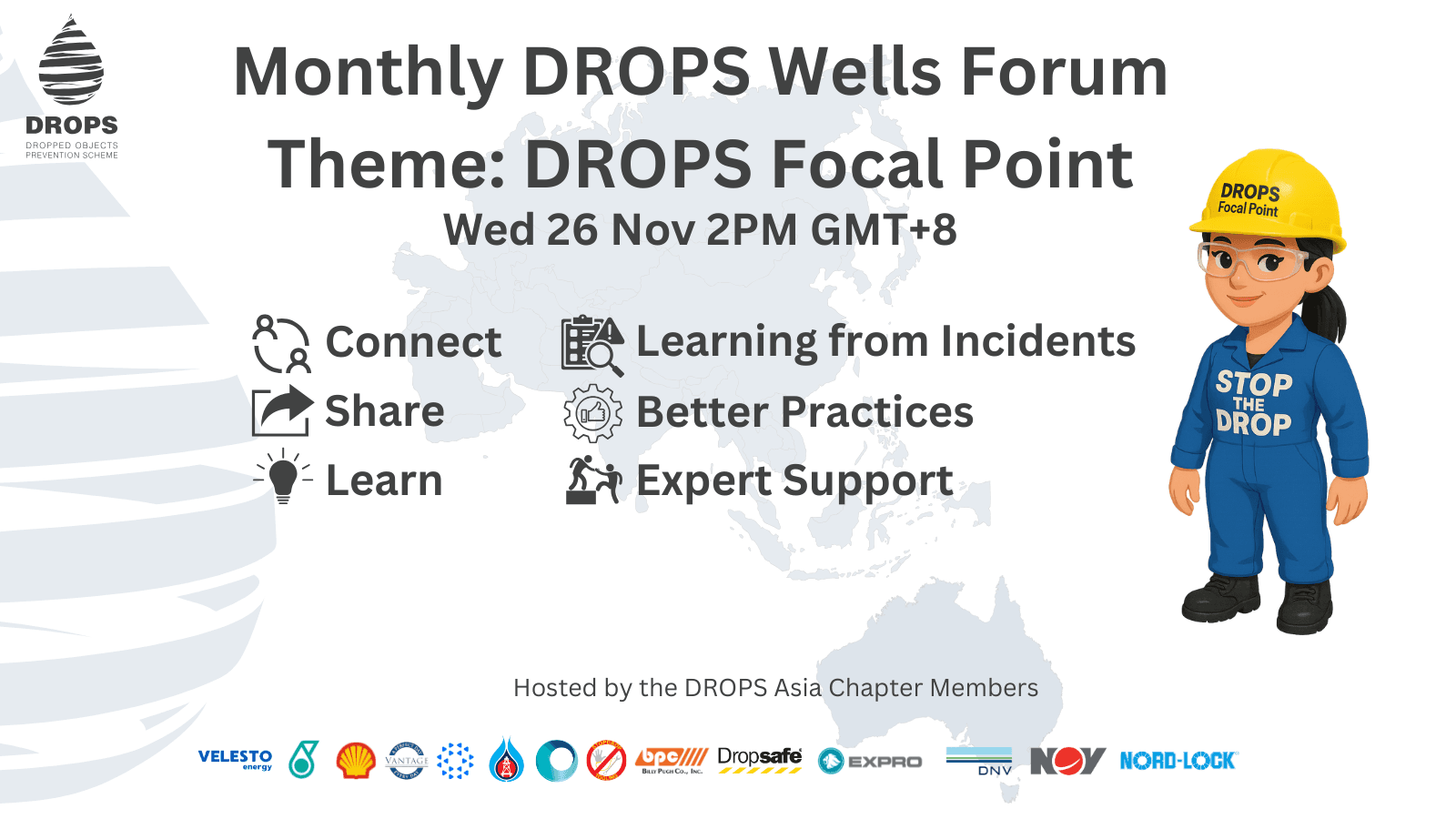
DROPS Forum – Focal Point Focus
When no one owns the dropped‑object risk, inspections become a tick in the box, actions stay open, learning stalls—and incidents rise. A strong Focal Point keeps prevention on track: clear mandate, steady inspection cadence, tight action closure, and alignment across operators, contractors, vendors/OEMs, logistics, and inspection bodies. Join our last DROPS forum of 2025 to see what “good” looks like and how to enable the role for impact.
Date & Time
No upcoming dates scheduled
Location
MS Teams
Organizers
Drops Asia Chapter
Recording available
When no one owns the dropped‑object risk, inspections become a tick in the box, actions stay open, learning stalls—and incidents rise. A strong Focal Point keeps prevention on track: clear mandate, steady inspection cadence, tight action closure, and alignment across operators, contractors, vendors/OEMs, logistics, and inspection bodies. Join our last DROPS forum of 2025 to see what “good” looks like and how to enable the role for impact.
View recordingIn the last DROPS Forum of 2025 we discussed the role of the DROPS Focal Point.
The presentation highlights how DROPS focal points once played a central role in preventing dropped-object incidents across the drilling sector. These specialists coordinated programs, standardized inspections, closed out incident actions, trained crews, aligned contractors, and helped develop recommended practices. Their deep expertise—built through involvement in workshops, peer collaboration, and continuous learning—enabled significant reductions in dropped objects, particularly in complex equipment such as top drives.
Over time, as incidents decreased and organizational priorities shifted, many focal-point roles were handed to successors with less experience or removed altogether. The result has been a gradual erosion of discipline: open actions linger, lessons fail to circulate, contractor alignment weakens, workforce awareness declines, and new solutions are adopted slowly. Without a knowledgeable owner, companies struggle to scope inspections properly, select competent vendors, interpret recommendations, or balance consequence with likelihood when making risk decisions. This leads to repeated incident patterns, disputes between operators and contractors, and overreliance on administrative controls such as Red Zones that are often poorly designed.
The presentation identifies key success factors in reversing this slide: strong leadership from the operator, a clear mandate, adequate resources, and sustained competency development. To rebuild lost expertise, a new DROPS Focal Point Program has been created—an in-depth, 6–18-month curriculum combining workshops, assignments, exams, and specialization tracks. Participants apply improvements throughout the program and receive active support from facilitators. Launching in early 2026, the program is open to DROPS Asia Chapter members, who may nominate up to five participants and access workshops and certification as part of their membership.
Full Transcript of presentation:
In the last Forum of 2025, we talked about a subject that incorporates some of the topics discussed this year and allows us to look forward to 2026.
As a safety professional, you manage many different risks. In the drilling sector, some of the key focus areas include pressure control, the environment, hands and fingers, working at height, lifting, and of course, dropped objects. It can be a juggling act giving enough attention to all subjects. When attention shifted to managing the COVID pandemic for example, many other topics took a back seat.
This is a picture taken during one of the workshops we organized in 2013, focused on managing dropped objects from top drives. It was attended by several operators, contractors, inspection companies, classification societies, and NOV. The representatives were all subject matter experts in this field and most were the DROPS focal points for their respective organizations. They had all done their homework before the workshop and stayed involved in closing out findings afterward. Through this workshop and network, NOV has been able to drastically reduce dropped objects from top drives.
In 2013, many operators and drilling contractors had subject matter experts like this, they could volunteer to participate in workshops like this. We call them drops for the points, some organizations use the term Drops Champion or DROPS Warden and sometimes even drops cop.
These DROPS focal points were also involved in drafting many of the DROPS recommended practices.
Within their companies, the DROPS focal point is the central node in a complex network. Their responsibilities stretch across nearly every part of the safety system.
They coordinate programs — keeping policies, checklists, and registers consistent.
They oversee inspections — ensuring they’re not just done, but done well.
They follow up on incidents — making sure investigations go beyond root causes to identify systemic issues. They train and coach others.
They maintain communication between departments, contractors, and vendors — translating technical detail into practical action.
They also work with peers, vendors and the DROPS Forum to develop new solutions. Think of solutions like tools at height and the safety netting that some of our member companies provide.
Following the successful implementation of a DROPS program, which resulted in a great reduction in incidents, it was time for these focal points to pass on the responsibility. Naturally, not being involved in designing the program, the successor did not have as much knowledge, and as incidents had greatly reduced, there was less incentive to learn. This cycle continued until the position disappeared or existed only on paper. This is the reality many companies in the drilling sector face today.
So, what happens when that role doesn’t exist — or when it’s given to someone without the authority or time to do it properly?
Actions from previous incidents or inspections stay open — not because people don’t care, but because no one is driving closure.
Lessons don’t circulate — each site learns the same hard way, again and again.
Contractors drift out of alignment — using different registers, standards, or even definitions of what counts as a dropped object.
Workforce awareness fades — toolbox talks become repetitive, inspections become routine, and technical competency declines.
New solutions and ideas are adopted more slowly, providing less incentive for vendors to innovate.
Recommended Practices are not maintained or updated further slowing the adoption of new ideas and solutions
The impact is subtle but dangerous. It’s not one big failure — it’s a slow erosion of focus. And before long, you start to see the same incident types returning, despite all the tools and procedures being in place.
And when a serious incident happens, the blame game starts. “It’s the responsibility of the main contractor to manage this,” says the operator. “We just had a survey done,” says the contractor. “You didn’t close out our recommendations,” says the inspector. And so on.
A few more examples we heard several times this year.
After a DROPS survey, companies still see frequent dropped objects and blame the inspection vendor. Part of the problem is not having someone who truly understands DROPS to set the scope and select the vendor. Lowest-bid awards often mean loosely managed freelancers with limited experience and little oversight. In many cases, their understanding of dropped object prevention is weaker than the crew’s.
Procurement compares day rates, reporting fees, and the number of days. More days usually means more coverage—but how much is enough? Some vendors promise the same work in less time using digital tools or drones. Is that proven capability or just a sales line? Without a knowledgeable owner, those claims and the actual effort required go unchallenged.
Inspectors can apply reliable-securing principles, but many don’t know drilling equipment in depth. If they aren’t given time to research, they miss product alerts and lessons from prior incidents. That gap shows up in missed hazards.
Inspection recommendations are often misunderstood, which drives disputes between the hiring company and the asset owner. We’ve seen engineering teams push to close low-significance findings while resources would be better spent on higher-value safety work. Without a focal point, close-out quality and prioritization suffer.
People learn the DROPS Calculator and focus on potential consequence. But potential consequence without likelihood is not risk. We see preventive solutions implemented for high-consequence, very low-likelihood scenarios, while common exposures persist. The hierarchy of controls is skipped: engineered fixes are adopted before considering substitution or elimination.
Red Zone Management.
We accept that drops may not be fully eliminated, so we try to fail-safe by keeping people out of the line of fire. But Red Zones are administrative and full of exemptions. AI Red Zone Monitoring, which many of our members are experimenting with, has exposed that many policies were weakly designed to begin with.
Tools at height
Good solutions exist, yet we see frequent cases of poor use—or no use at all.
Bottom line
These patterns repeat when no one owns DROPS end-to-end. A focal point doesn’t do the work alone—but they set scope, challenge vendor claims, ensure research time, interpret findings, and keep risk decisions anchored in both consequence and likelihood.
So, what separates the strong programs from the struggling ones? These are recurring success factors we’ve identified through our work with operators and contractors.
Leadership and mandate.
This starts with whichever party holds the overall safety responsibility for a site drilling sector this is the operator.
They set the tone. If it’s important to them, it becomes important to the entire supply chain. If they have an active DROPS focal point, their vendors will make sure to assign a counterpart.
The focal point must have visible sponsorship, resources, and clear authority. If they’re squeezed between priorities or constantly firefighting, the system will collapse.
Competency and training. This is not a one-day course. It’s built through experience, self-study, connecting with peers, reinforcement, and refreshers. The focal point must understand both the technical and human aspects of DROPS.
We have listed several other important subjects, but these are all easier to address once you appoint and support a DROPS focal point in your organization.
Becoming a DROPS Focal Point Isn’t something you cover in a one-day course. Rebuilding foundations and developing specializations takes time, and many organizations have lost that depth. To address this, we have designed a program to help teams regain it.
The program is a comprehensive series of workshops, assignments, and tests that runs
6–18 monthsdepending on specialization. It begins with basic awareness, moves into the fundamentals, and then participants select a specialization . At the end, there is an examination and a final project aligned to the chosen specialization.
Each module includes a short exam to verify learning. Participants don’t wait until the end to apply ideas; they are expected to implement improvements as they progress. Focal points nominated by our member companies will receive active support from me throughout—guidance on priorities, feedback on deliverables, and help removing blockers.
The program will
roll out in early 2026 and will be refined continuously based on participant and member feedback. The subjects listed on this slide are representative of what we cover; they are not exhaustive. The goal is capability that sticks: sound foundations, targeted specialization, and measurable improvement in dropped-object risk.
DROPS Asia Chapter Members will be invited to nominate up to 5 participants, and all the workshops and certification are included in their membership fee.
This year, we have already developed the basic awareness which takes about an hour to complete. It is in the form of a Snakes and Ladders game, and you are encouraged to play it competitively in a team of four. At the end, each participant can complete a simple test and obtain a certificate of completion.
So far, we have developed four core modules to get the program started. These include an overview of the various recommended practices, risk assessments, red zone management and tools at height. More content is under development. You will find a course outline and registration details in the notes of this recording
If you have any questions or would you like to nominate yourself or a colleague for this program? We look forward to hearing from you.
Registration is closed - no upcoming dates scheduled