
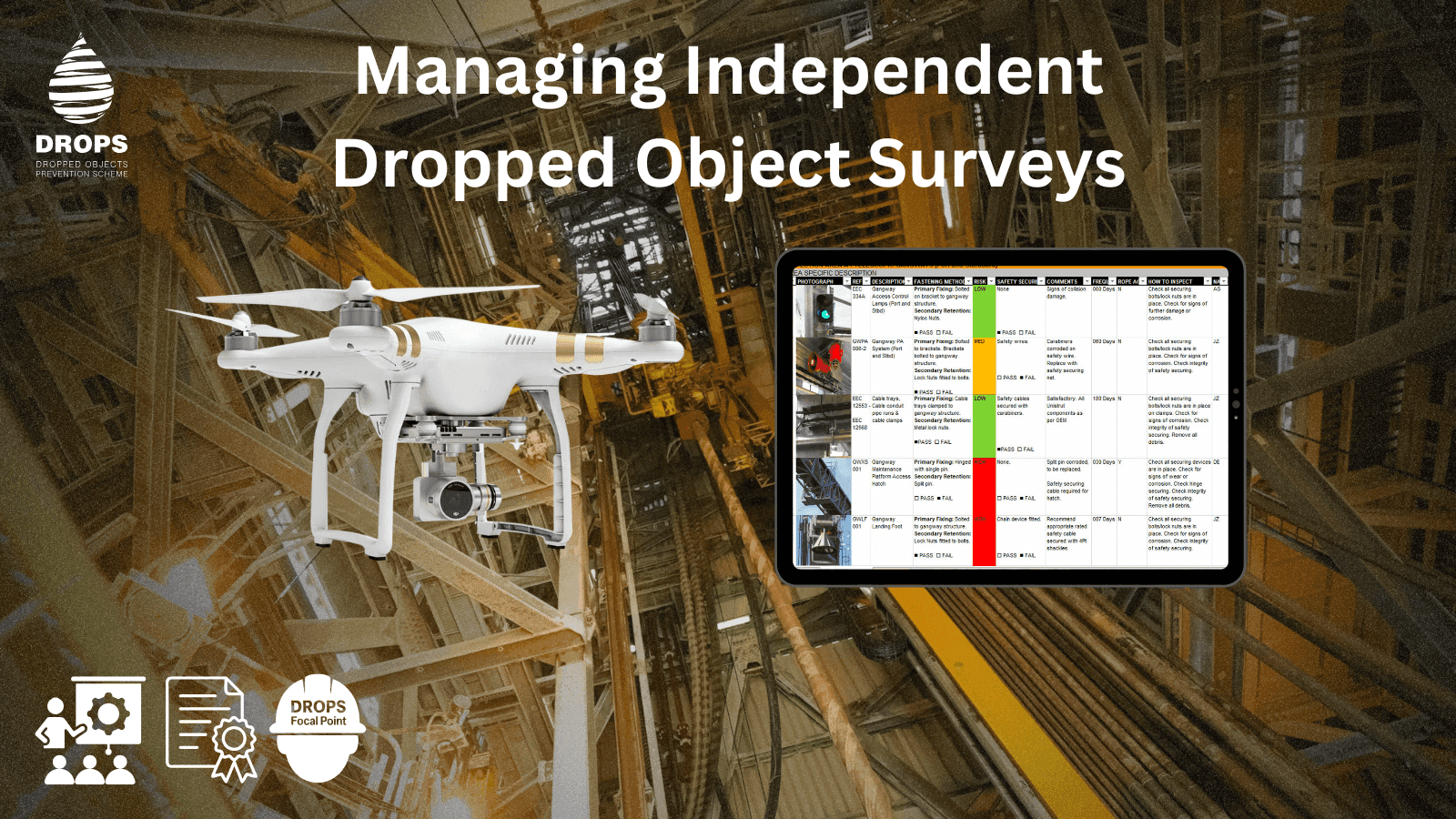
Managing Independent Dropped Object Surveys
A management-focused workshop examining how Independent Dropped Object Surveys fit within the wider DROPS programme. The session explores provider selection, competency, inspections versus auditing, use of technology, and common misunderstandings between asset owners, operators, and inspection companies, with the aim of improving assurance value and dropped object risk control.
Date & Time
Tue 17 Nov 3:00PM GMT+8 to Tue 17 Nov 4:30PM GMT+8
Cost
Member: USD 0.00
Non-Member: USD 50.00
Format: Interactive management workshop
Duration: 90 minutes
Managing Independent Dropped Object Surveys
Independent Dropped Object Surveys are widely used across the industry, but the value they deliver can vary significantly.
In some organisations, surveys are actively managed as part of a wider DROPS prevention programme. In others, they are treated mainly as a compliance requirement — procured at lowest cost, repeated every few years, and disconnected from the asset owner’s own risk register, inspection system, and follow-up process.
This workshop is designed to help participants use the DROPS Recommended Practice for surveys more effectively: not only to understand what it requires, but also to understand how it fits into the wider DROPS prevention programme, where it can fail in practice, and what better management looks like.
Why this workshop matters
Independent surveys are intended to provide periodic, objective assurance within a broader DROPS management system. They are not meant to replace routine internal inspections, nor to transfer ownership of dropped object risk away from the asset owner or contractor.
In reality, many organisations still face recurring issues such as:
major findings discovered late, close to customer acceptance
repeated rediscovery of old issues due to weak record continuity
disputed findings with limited technical basis
fragmented reporting spread across PDFs, spreadsheets, and inspection books
poor value caused by weak procurement models or insufficient technical oversight
This workshop addresses those realities directly.
What the session will cover
The session will use the DROPS Recommended Practice for surveys as its starting point and then place it in the wider context of dropped object prevention, including risk assessment, equipment-at-height control, systematic inspection, maintenance, reliable securing, assurance, and close-out.
Topics will include:
how independent surveys fit within a wider DROPS prevention programme
the link between risk assessment, equipment-at-height registers, inspection criteria, and survey scope
the difference between first-time baseline surveys and repeat verification surveys
where responsibilities sit between drilling contractors, operators, and third-party survey companies
common weaknesses in practice, including compliance-driven contracting, weak technical oversight, and fragmented reporting
how to manage findings, disputed findings, and accepted deviations more effectively
how digital tools, structured data, and better reporting can improve efficiency and reduce repeat effort
how surveys can be used for capability-building and improvement, not just compliance
Key themes
1. Surveys are part of a wider system
Independent surveys only add value when they are connected to a wider DROPS prevention programme. That includes risk assessment, equipment identification, reliable securing, routine inspection, maintenance, and effective follow-up.
2. Ownership matters
The drilling contractor or asset owner should own the process, the baseline, and the close-out logic. The operator needs to verify that this system is robust. The third-party survey company should verify, challenge, and support the process — not substitute for it.
3. First survey and repeat survey are not the same
A first survey may help establish the initial baseline. Repeat surveys should start from an existing controlled baseline and focus on discrepancies, omissions, deterioration, modifications, and improvement opportunities.
4. Lowest cost does not equal best value
Poorly managed, lowest-bidder surveys often lead to weak technical oversight, inconsistent findings, poor reporting, and avoidable cost later in the process.
5. Data quality drives assurance quality
Static Word or PDF reports may satisfy a minimum requirement, but they are a weak basis for managing a living equipment-at-height system over time. Structured data, digital tools, and better integration between asset owners and third-party survey companies can significantly improve efficiency and control.
Who should attend
This workshop is intended for:
drilling contractors and asset owners responsible for DROPS survey programmes
operators who need to verify that contractor DROPS systems are effective
OIMs, rig managers, facility managers, and technical authorities
HSE, integrity, and assurance leaders
managers of third-party inspection companies
What participants will gain
Participants will leave with:
a clearer understanding of how to use the survey Recommended Practice in practice
a better view of how surveys fit within a wider DROPS prevention programme
practical insight into what makes repeat surveys more efficient, useful, and credible
a stronger understanding of the roles of contractors, operators, and third-party survey providers
a clearer picture of why some survey programmes create value while others create friction, cost, and repeated surprise
a more informed view of how digital tools and structured data can improve long-term control
Why attend
The purpose of this workshop is not simply to explain that independent surveys are required. It is to help participants understand how to use them well.
Where surveys are treated as assurance, they can strengthen control, improve visibility, build capability, and reduce surprises. Where they are treated as compliance, they often produce fragmented records, repeated rediscovery, disputed findings, and expensive remediation at the wrong time.
This session is intended to help organisations move toward the first model.