
Version history
What changed
The hammer head that came off. Every change since the first published draft: what we changed, why, and which comments led to it.
Version 2: the script now matches film v8, revised after reviewers’ comments on the forum draft of 28 October 2026.
- About this draft, part 1Reworded
The status note describes version 2.
Forum draftVersion 2 · Not yet published.Draft for discussion at the DROPS Forum on 28 October 2026.Revised from the forum draft of 28 October 2026 after reviewers' comments; “What changed” lists each change and the comment behind it. The film and its script may still change before publication.Why: The note at the top of the page describes version 2.
- 1 Opening, part 6Reworded
'Handle' becomes 'shaft'.
After thirteen years in service, on an ordinary day on the drill floor of a drilling rig, it came off its
handleshaft and fell about three metres to the deck.Why: The narration and the on-screen graphics call this part the shaft instead of the handle.
What led to this
- Call the handle the shaftAdopted as proposed
Raised in 2 reviewer comments.
- 1 Opening, part 8Reworded
'Handle' becomes 'shaft'.
Nobody was under it. The
handleshaft stayed on its tether. The head did not.Why: The narration and the on-screen graphics call this part the shaft instead of the handle.
What led to this
- Call the handle the shaftAdopted as proposed
Raised in 2 reviewer comments.
- 1 Opening, part 10Moved
Moved to the opening, after 'The head did not.'
The incident was classed as high potential.
Now comes after
Nobody was under it. The shaft stayed on its tether. The head did not.
.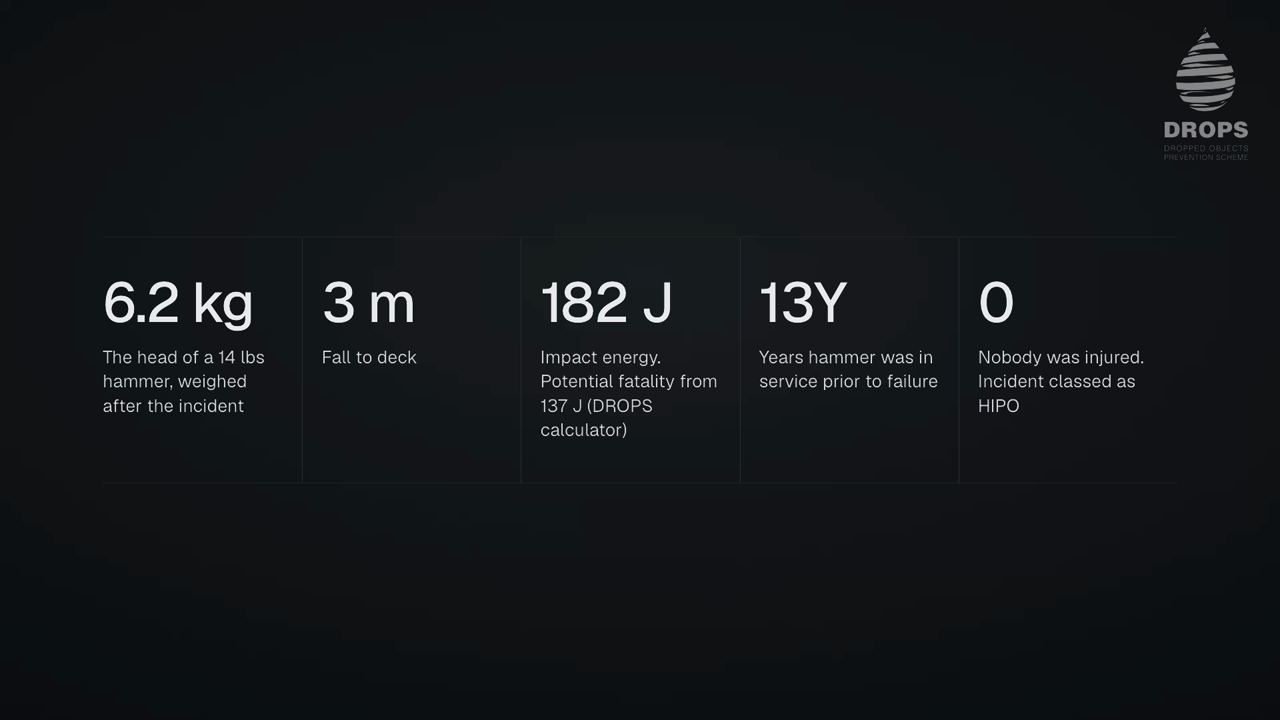
Before 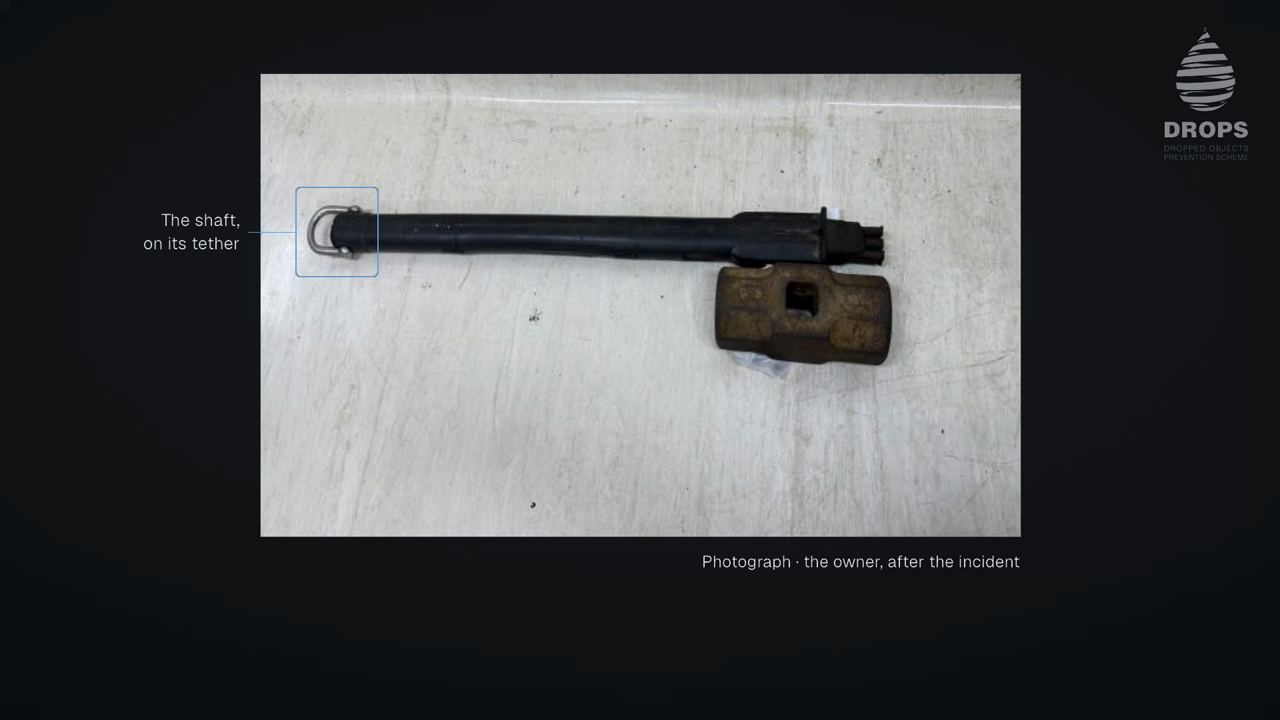
After Why: The high-potential classification moves to the opening.
What led to this
- Move 'high potential' earlierAdopted in a different form
Moved up to the end of the opening, at about 0:23 rather than 0:15.
Raised in 1 reviewer comment.
- 1 Opening, part 16Moved and reworded
Reworded, and moved up to follow the title.
Nobody was hurt.
It is shared so thatWe're sharing this so it stays that way.Now comes after
The hammer head that came off.
.Why: The sentence is reworded and moved to follow the title.
What led to this
- Say 'Nobody was hurt' straight after the titleAdopted as proposed
Raised in 2 reviewer comments.
- 1 Opening, part 22Reworded
Describes the hammer as a composite type designed to keep the head on the shaft.
The tool was a purpose-designed hammer for work at height,
the kind bought as the answer to dropped hammer heads.a composite type to reduce the likelihood of the hammer head parting from the shaft.Why: The tool is described by its construction and purpose.
What led to this
- Describe the hammer as a composite typeAdopted as proposed
Raised in 1 reviewer comment.
- 1 Opening, part 24Reworded
'Handles' becomes 'shafts'.
Hammer heads coming off wooden and fibreglass
handlesshafts were a known cause of dropped objects.Why: The narration and the on-screen graphics call this part the shaft instead of the handle.
What led to this
- Call the handle the shaftAdopted as proposed
Raised in 2 reviewer comments.
- 1 Opening, part 32Reworded
The claim that the maker gives no pass or fail criteria is removed.
The
maker gives no pass or fail criteria for these hammers, and thelock that failed is hidden inside the head.Why: The statements about the maker's pass or fail criteria are removed.
What led to this
- Remove the pass or fail claim about the makerAdopted as proposed
Raised in 1 reviewer comment.
- 2 How it is built, part 6Reworded
'Shelf' becomes 'shoulder, a step inside the hole'.
A hole runs right through the head, and part way down it narrows to a
shelf.shoulder, a step inside the hole.Why: The narration and graphics call the narrowing inside the head a shoulder, and say once what it is.
What led to this
- Shelf or shoulder: name the narrowing in the headAdopted as proposed
Raised in 2 reviewer comments.
- 2 How it is built, part 8Reworded
'Shelf' becomes 'shoulder'.
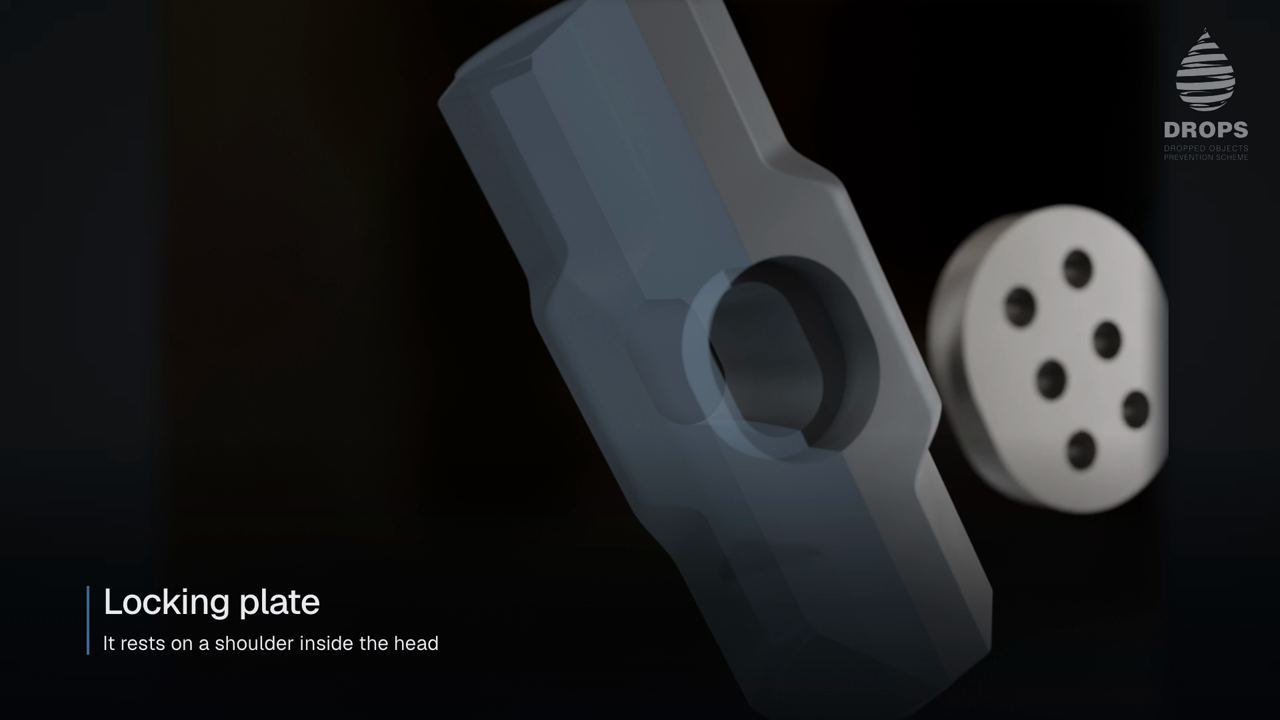
A steel locking plate sits on that
shelf.shoulder.Why: The narration and graphics call the narrowing inside the head a shoulder, and say once what it is.
What led to this
- Shelf or shoulder: name the narrowing in the headAdopted as proposed
Raised in 2 reviewer comments.
- 2 How it is built, part 12Reworded
'Handle' becomes 'shaft'.
The
handleshaft is a bundle of six steel rods, moulded together, running the full length of thehandleshaft and up through the head.Why: The six-rod sentence uses 'shaft'.
What led to this
- Describe the shaft as a bundle of six rodsAdopted in a different form
'Handle' is now 'shaft', as you suggested. The line keeps 'moulded together' rather than 'moulded in rubber'.
Raised in 1 reviewer comment.
- 2 How it is built, part 16Reworded
'Shelf' becomes 'shoulder'.
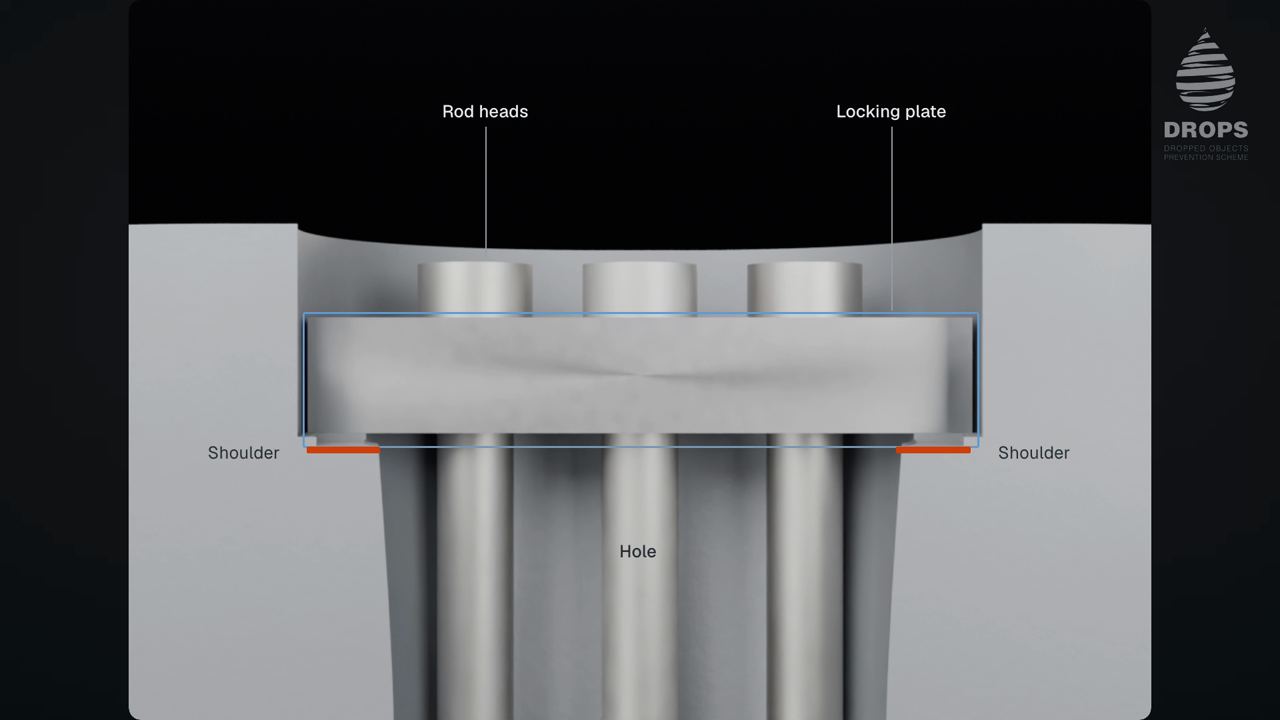
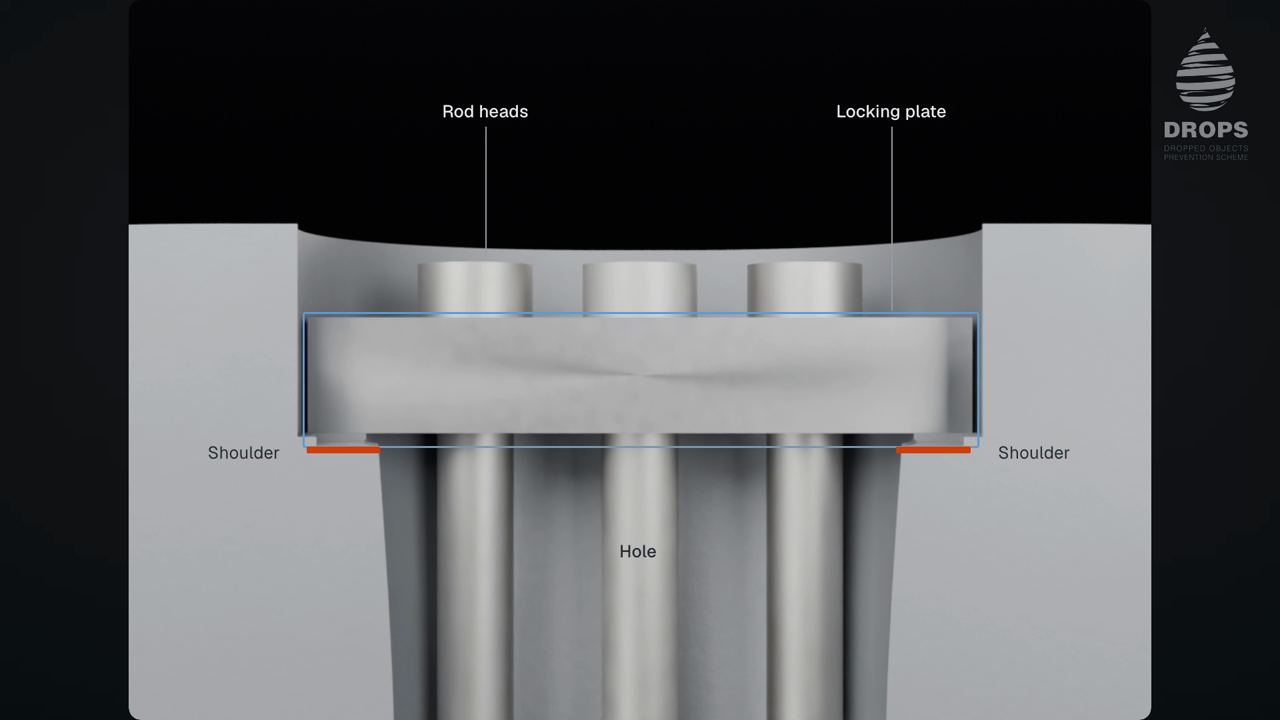
So the rod heads bear on the plate, and the plate bears on the
shelf.shoulder.Why: The narration and graphics call the narrowing inside the head a shoulder, and say once what it is.
What led to this
- Shelf or shoulder: name the narrowing in the headAdopted as proposed
Raised in 2 reviewer comments.
- 3 How it failed, part 18Reworded
'Shelf' becomes 'shoulder'.
It runs into the gap around the plate and settles in the crevice between the plate, the rod heads and the
shelf.shoulder.Why: The narration and graphics call the narrowing inside the head a shoulder, and say once what it is.
What led to this
- Shelf or shoulder: name the narrowing in the headAdopted as proposed
Raised in 2 reviewer comments.
- 3 How it failed, part 22Reworded
'That corrosion is the main issue' is removed.
Each time the head gets damp again, the rust grows.
That corrosion is the main issue.Why: 'That corrosion is the main issue' is removed.
What led to this
- Soften the corrosion statementAdopted in a different form
We removed the claim that corrosion is 'the main issue' and kept the shorter 'each time the head gets damp again, the rust grows'.
Raised in 1 reviewer comment.
- 3 How it failed, part 24Reworded
'Handle' becomes 'shaft'.
What gives way is the narrow rim of plate under each rod head. That rim is all that holds the hammer head to its
handle.shaft.Why: The narration and the on-screen graphics call this part the shaft instead of the handle.
What led to this
- Call the handle the shaftAdopted as proposed
Raised in 2 reviewer comments.
Now says there is typically no recommended service life on these tools.
The maker puts noTypically there is no recommended service life on thesehammers.tools.Why: The service-life sentence uses the reviewer's wording.
What led to this
- Service life: use Allen's wordingAdopted as proposed
Raised in 1 reviewer comment.
Names the maker as the source of the guidance.
ItsThe maker's guidance is to clean and inspect the hammer before and after use, and to take it out of service on what the inspection finds.Why: The sentence names the maker as the source of the guidance.
What led to this
- State the maker's guidance clearlyAdopted in a different form
The line now opens 'The maker's guidance is…'. We did not use the stronger 'clearly states… must', because we only quote the maker in words they have confirmed to us.
Raised in 1 reviewer comment.
- lfi-51n3Removed
Sentence removed: 'The maker does not set pass or fail criteria for these hammers.'
The maker does not set pass or fail criteria for these hammers.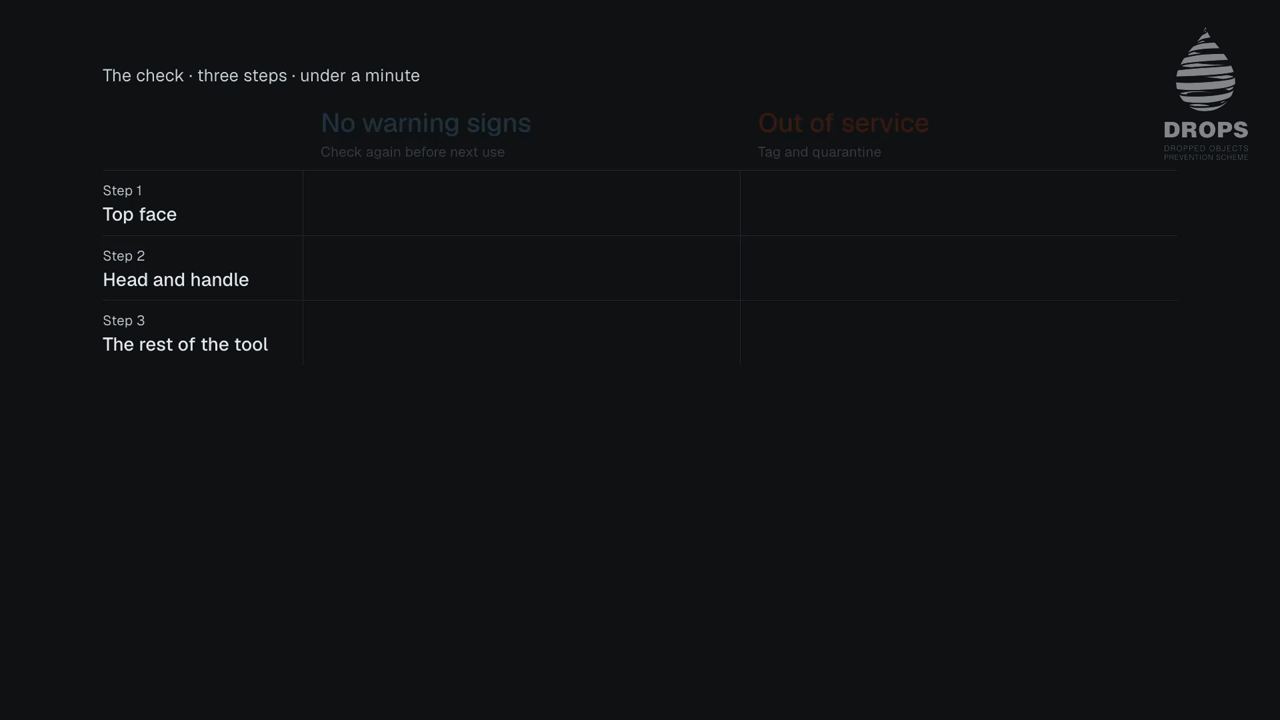
Picture removed Why: The statements about the maker's pass or fail criteria are removed.
What led to this
- Remove the pass or fail claim about the makerAdopted as proposed
Raised in 1 reviewer comment.
- 5 The check, part 6Reworded
Now says the steps were put together by the DROPS Asia chapter.
These steps
arewere put together by the DROPS Asiachapter's own.chapter.Why: The sentence says the DROPS Asia chapter put the steps together.
What led to this
- Don't present DROPS Asia as the authorityAdopted in a different form
Reworded rather than removed: 'These steps were put together by the DROPS Asia chapter.' It credits the chapter without claiming authority.
Raised in 1 reviewer comment.
- 5 The check, part 12Reworded
Adds 'immediately'.
If you find any one of them, take it out of
service.service immediately.Why: The instruction says 'immediately'.
What led to this
- Take it out of service immediatelyAdopted as proposed
Raised in 1 reviewer comment.
- 5 The check, part 38Reworded
'Handle' becomes 'shaft'.
Step two, the head and the
handle.shaft.Why: The narration and the on-screen graphics call this part the shaft instead of the handle.
What led to this
- Call the handle the shaftAdopted as proposed
Raised in 2 reviewer comments.
- 5 The check, part 40Reworded
'Handle' becomes 'shaft'.
Hold the
handleshaft still. Clamp it in a vice, or lay it on the toolbox with the head out over the edge, and press thehandleshaft down.Why: The narration and the on-screen graphics call this part the shaft instead of the handle.
What led to this
- Call the handle the shaftAdopted as proposed
Raised in 2 reviewer comments.
- 5 The check, part 44Reworded
Reworded as an instruction.
Any movement you can feel,If you feel any movement, a rock, turn or lift, however small,and it comestake the hammer out of service.Why: The movement check is written as an instruction.
What led to this
- Reword the movement check as an instructionAdopted as proposed
Raised in 1 reviewer comment.
- 5 The check, part 46Reworded
Now says the interlock has likely failed.
If
you can feel it,there is movement, it is likely the interlock hasalreadyfailed.Why: The sentence says the interlock has likely failed.
What led to this
- Say the interlock has likely failedAdopted as proposed
Raised in 1 reviewer comment.
- 5 The check, part 50Reworded
'Handle' becomes 'shaft'.
Look at the
handleshaft from the head to the butt, the attachment point, and the tool's ID and record.Why: The narration and the on-screen graphics call this part the shaft instead of the handle.
What led to this
- Call the handle the shaftAdopted as proposed
Raised in 2 reviewer comments.
- lfi-56n2Removed
Sentence removed: 'Any of the signs on screen takes it out of service.' The four sentences below replace it.
Any of the signs on screen takes it out of service.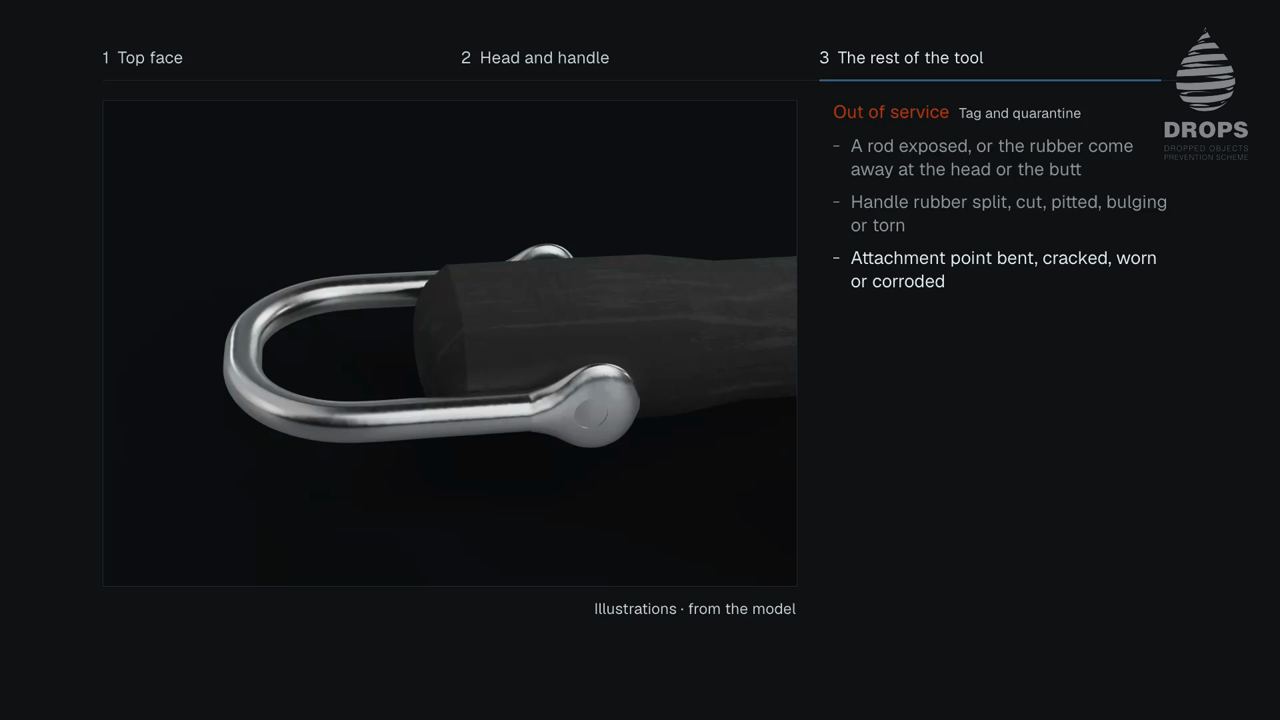
Picture removed Why: The single sentence pointing at the signs on screen is replaced by four sentences that say each sign.
What led to this
- Make the step-three signs readableAdopted in a different form
The line pointing at the on-screen list is gone. The narration now reads out the four signs instead.
Raised in 1 reviewer comment.
- 5 The check, part 52Added
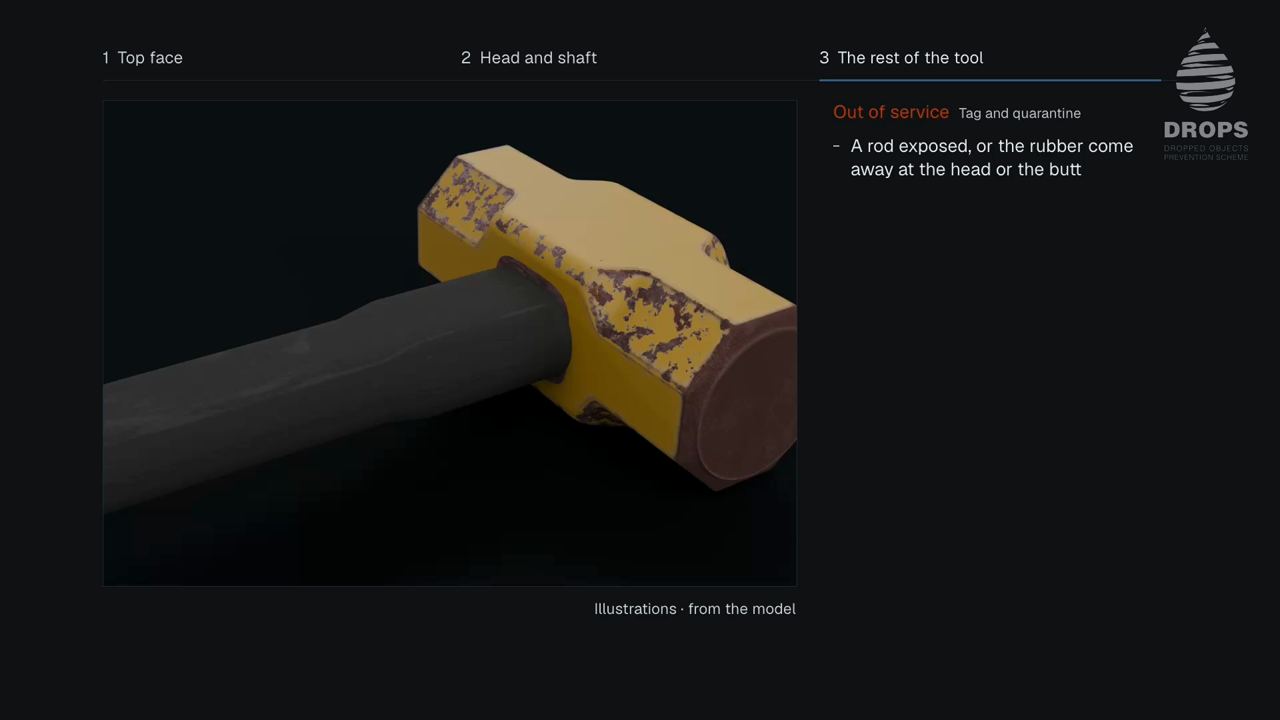
New sentence: 'Take it out of service if a rod is exposed, or the rubber has come away at the head or the butt.'
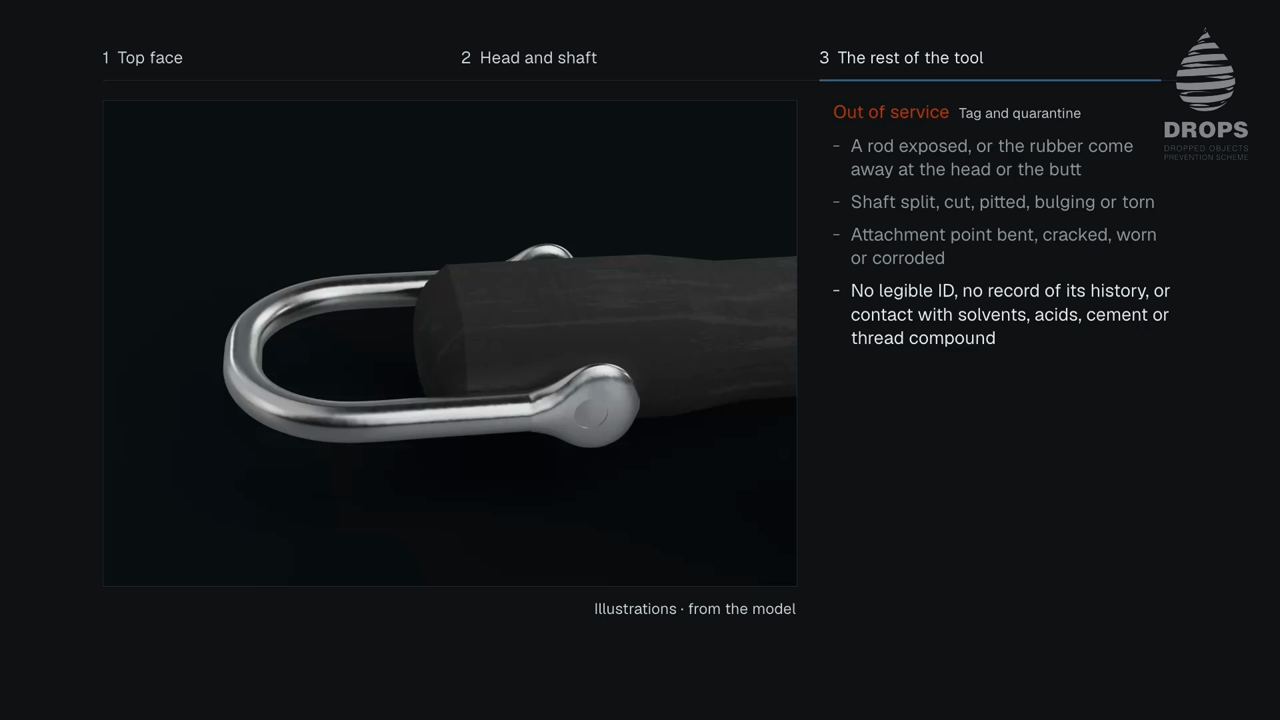
Take it out of service if a rod is exposed, or the rubber has come away at the head or the butt.
Now comes after
Look at the shaft from the head to the butt, the attachment point, and the tool's ID and record.
.
New picture Why: The single sentence pointing at the signs on screen is replaced by four sentences that say each sign.
What led to this
- Make the step-three signs readableAdopted in a different form
The line pointing at the on-screen list is gone. The narration now reads out the four signs instead.
Raised in 1 reviewer comment.
- 5 The check, part 54Added
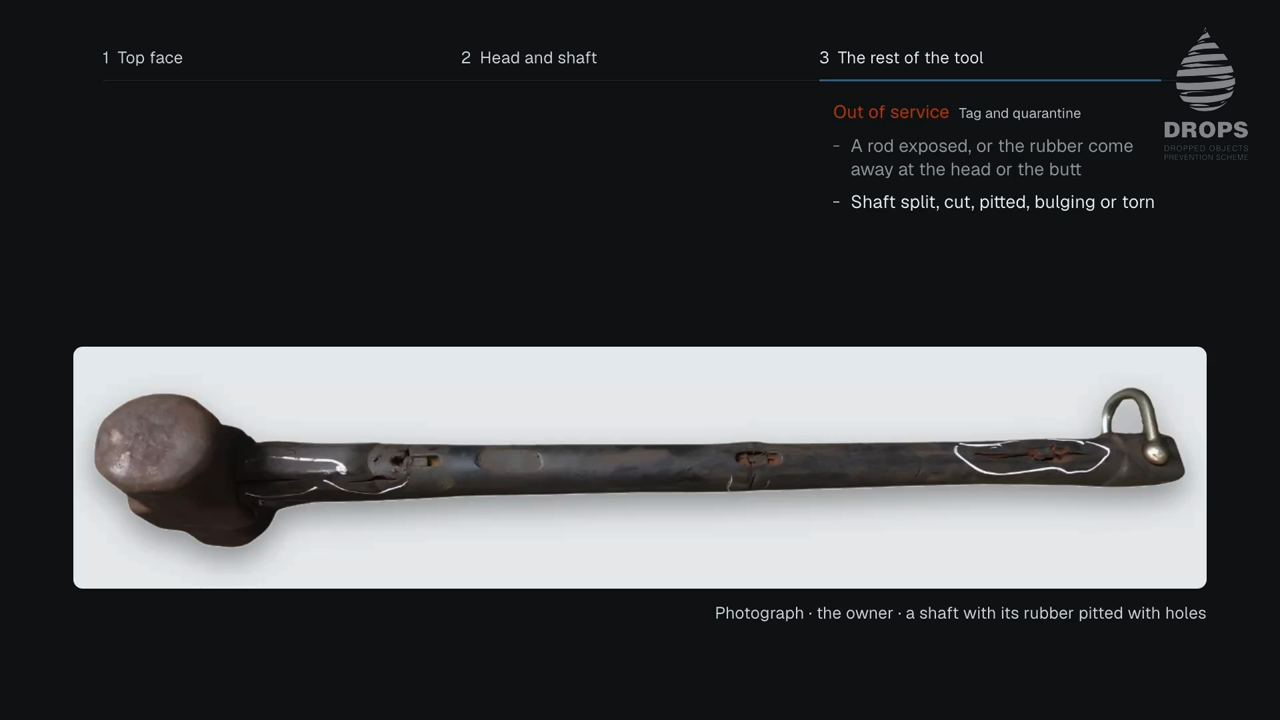
New sentence: 'If the shaft is split, cut, pitted, bulging or torn.'
If the shaft is split, cut, pitted, bulging or torn.
Now comes after
Take it out of service if a rod is exposed, or the rubber has come away at the head or the butt.
.
New picture Why: The single sentence pointing at the signs on screen is replaced by four sentences that say each sign.
What led to this
- Make the step-three signs readableAdopted in a different form
The line pointing at the on-screen list is gone. The narration now reads out the four signs instead.
Raised in 1 reviewer comment.
- 5 The check, part 56Added
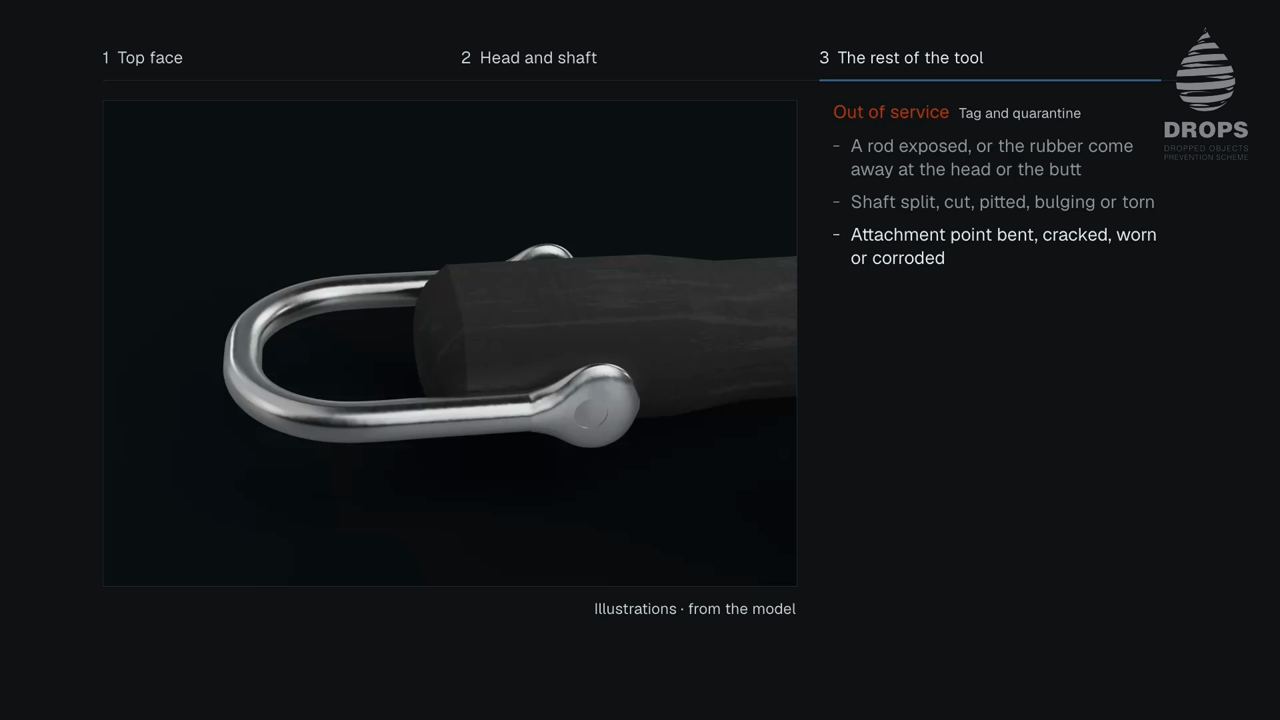
New sentence: 'If the attachment point is bent, cracked, worn or corroded.'
If the attachment point is bent, cracked, worn or corroded.
Now comes after
If the shaft is split, cut, pitted, bulging or torn.
.
New picture Why: The single sentence pointing at the signs on screen is replaced by four sentences that say each sign.
What led to this
- Make the step-three signs readableAdopted in a different form
The line pointing at the on-screen list is gone. The narration now reads out the four signs instead.
Raised in 1 reviewer comment.
- 5 The check, part 58Added
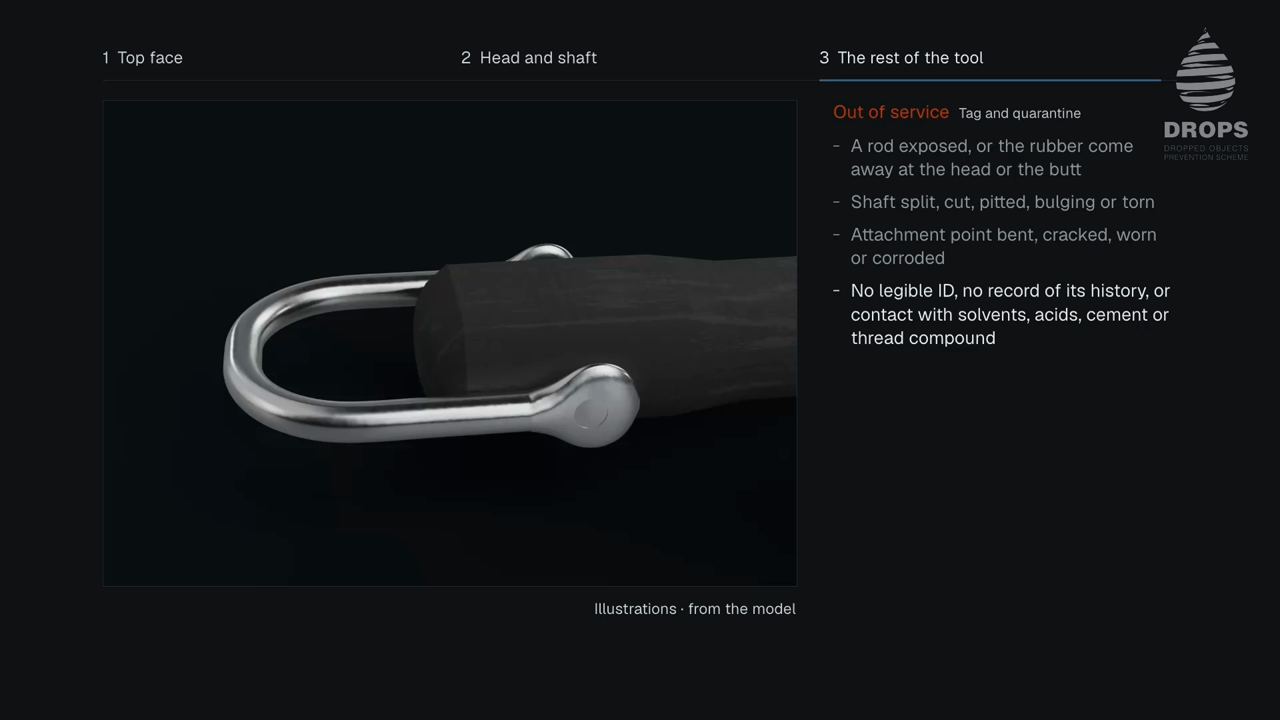
New sentence: 'Or if there is no legible ID, no record of its history, or it has been in contact with solvents, acids, cement or thread compound.'
Or if there is no legible ID, no record of its history, or it has been in contact with solvents, acids, cement or thread compound.
Now comes after
If the attachment point is bent, cracked, worn or corroded.
.
New picture Why: The single sentence pointing at the signs on screen is replaced by four sentences that say each sign.
What led to this
- Make the step-three signs readableAdopted in a different form
The line pointing at the on-screen list is gone. The narration now reads out the four signs instead.
Raised in 1 reviewer comment.
- 5 The check, part 60Reworded
Now says to take it out of service and seek advice from your technical authority or DROPS Focal Point.
When in any doubt,
isolatetake itand have it reviewed.out of service and seek advice from your technical authority or DROPS Focal Point.Why: The closing instruction names who to ask.
What led to this
- Point to the technical authority or DROPS Focal PointAdopted as proposed
Raised in 1 reviewer comment.
- New pictures
21 film stills retaken: the graphic now reads 'shaft'.
Show the 21 stills
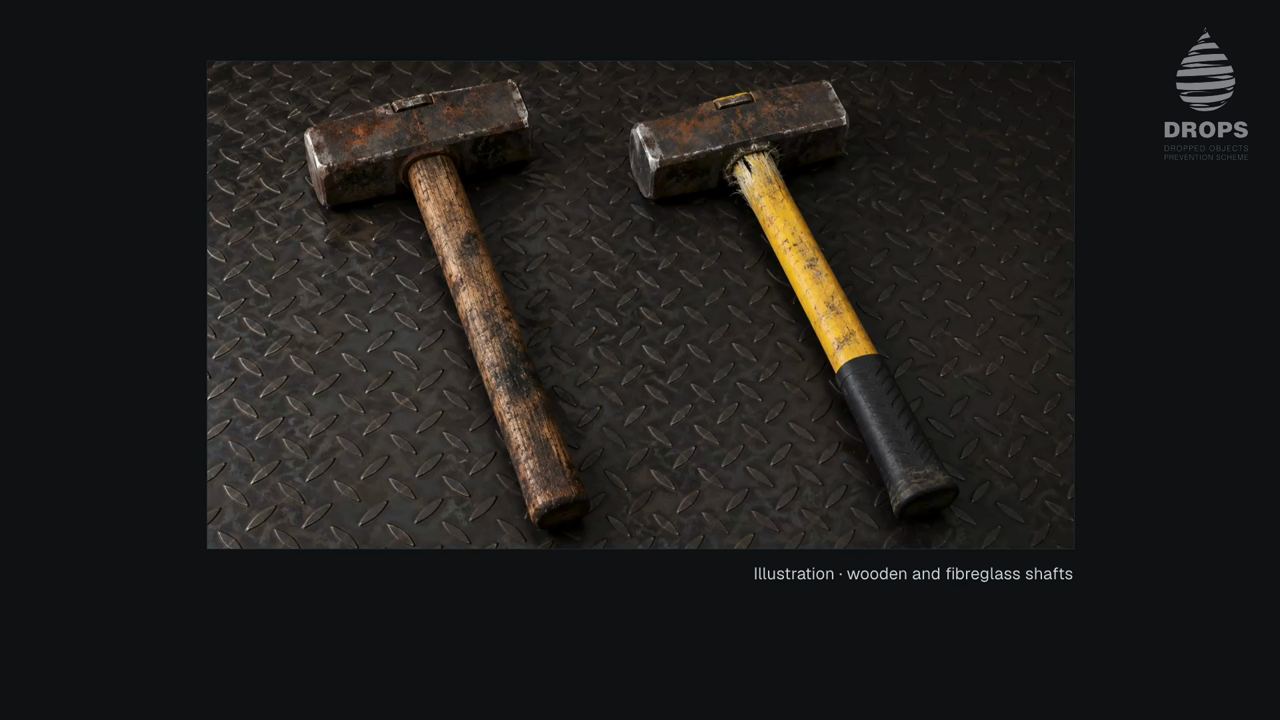 1 Opening, part 23At 1:01 in the film
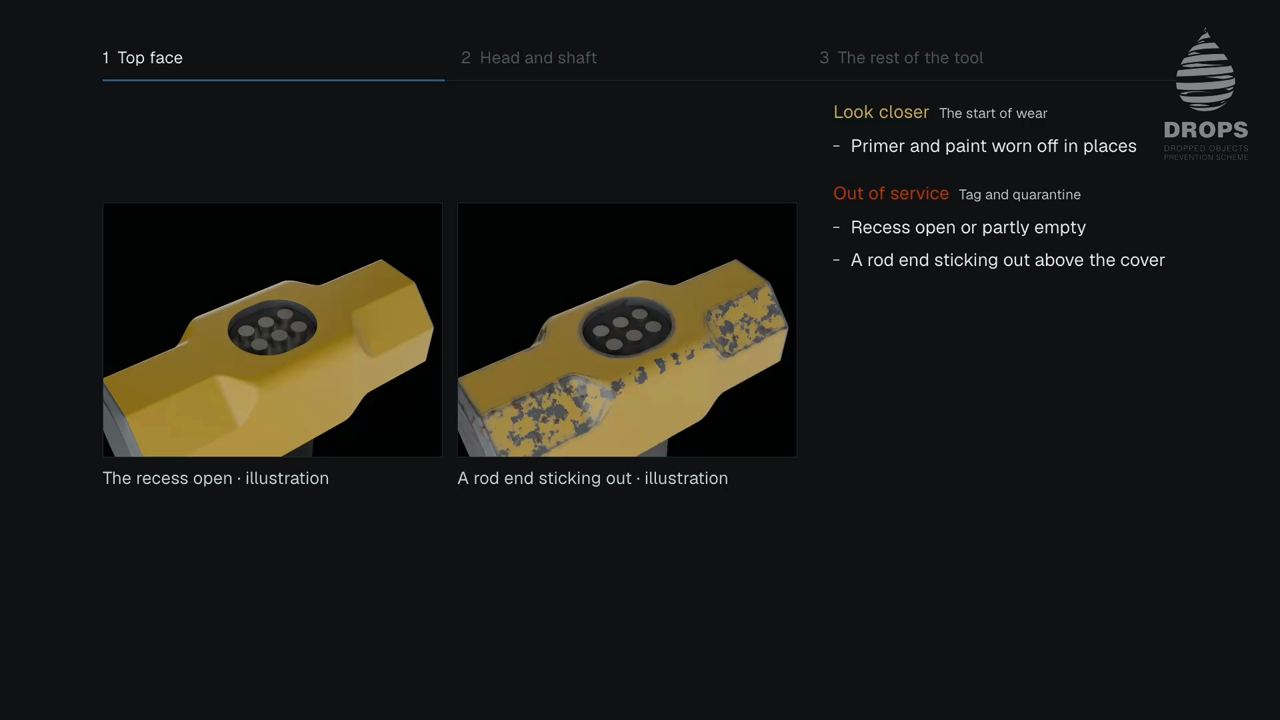 4 Does this apply to you?, part 3At 4:42 in the film
 4 Does this apply to you?, part 9At 4:59 in the film
 5 The check, part 3At 5:10 in the film
 5 The check, part 5At 5:13 in the film
 5 The check, part 7At 5:17 in the film
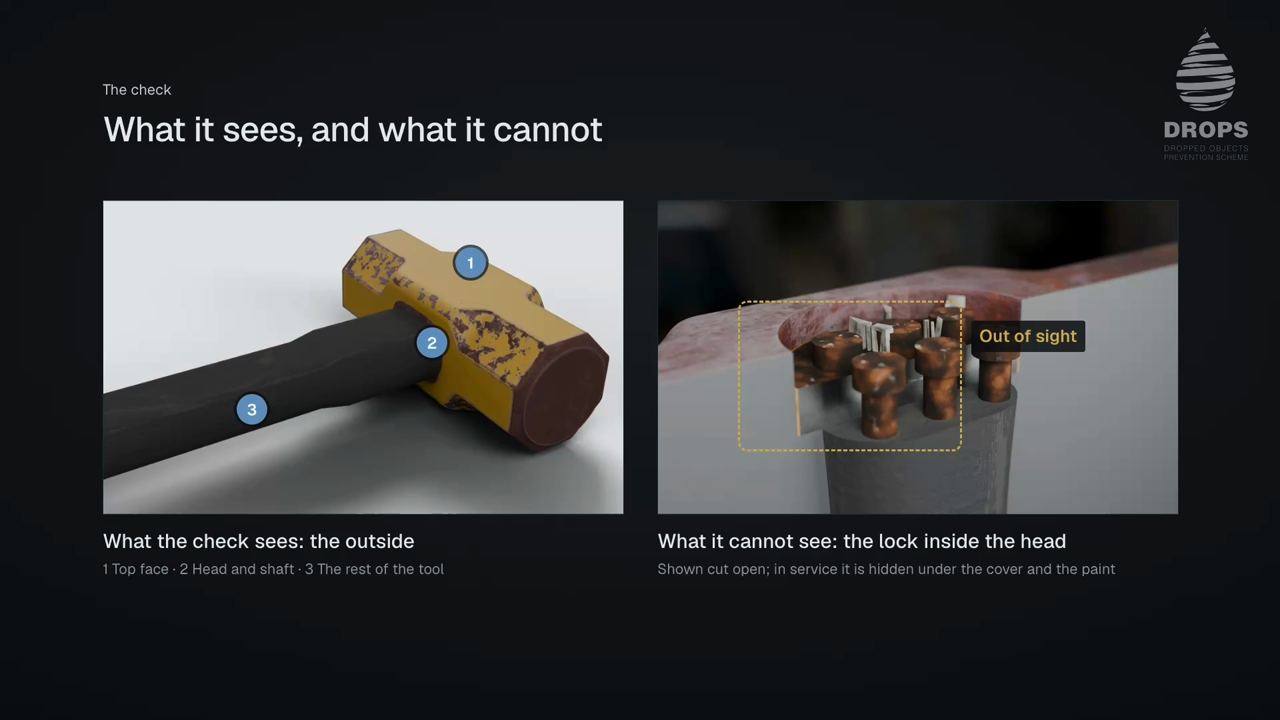 5 The check, part 9At 5:24 in the film
 5 The check, part 11At 5:31 in the film
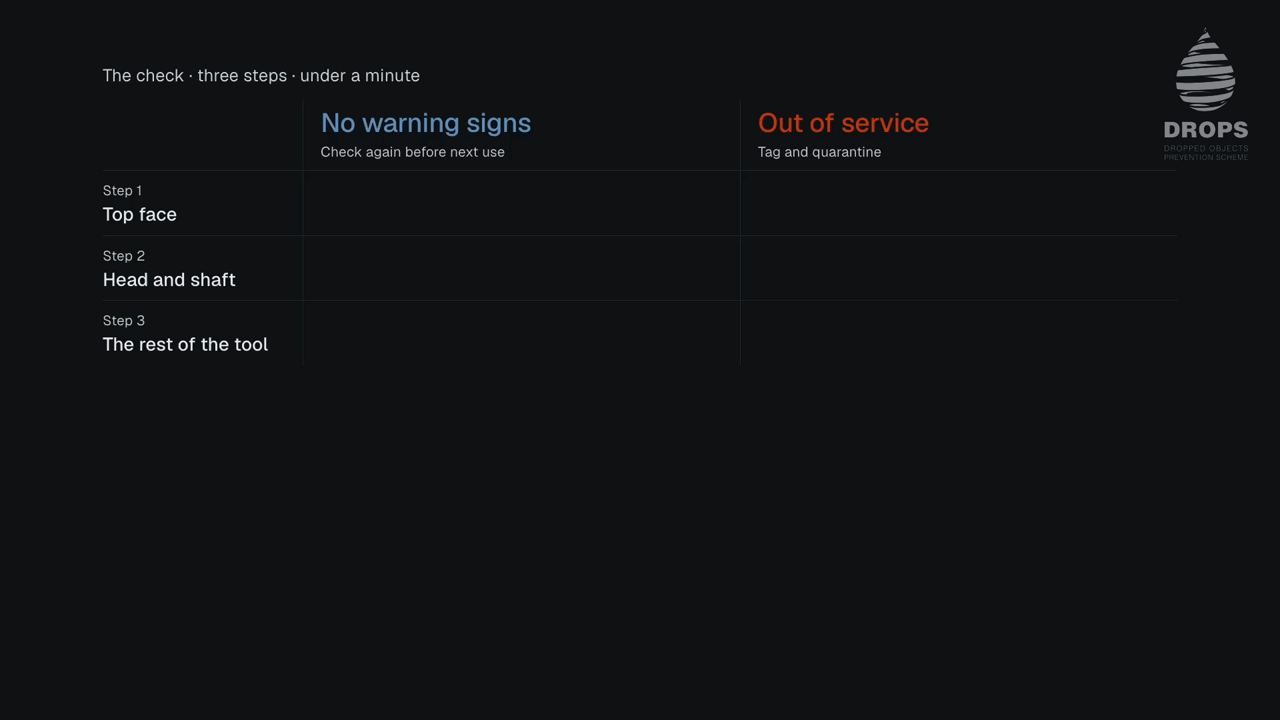 5 The check, part 13At 5:36 in the film
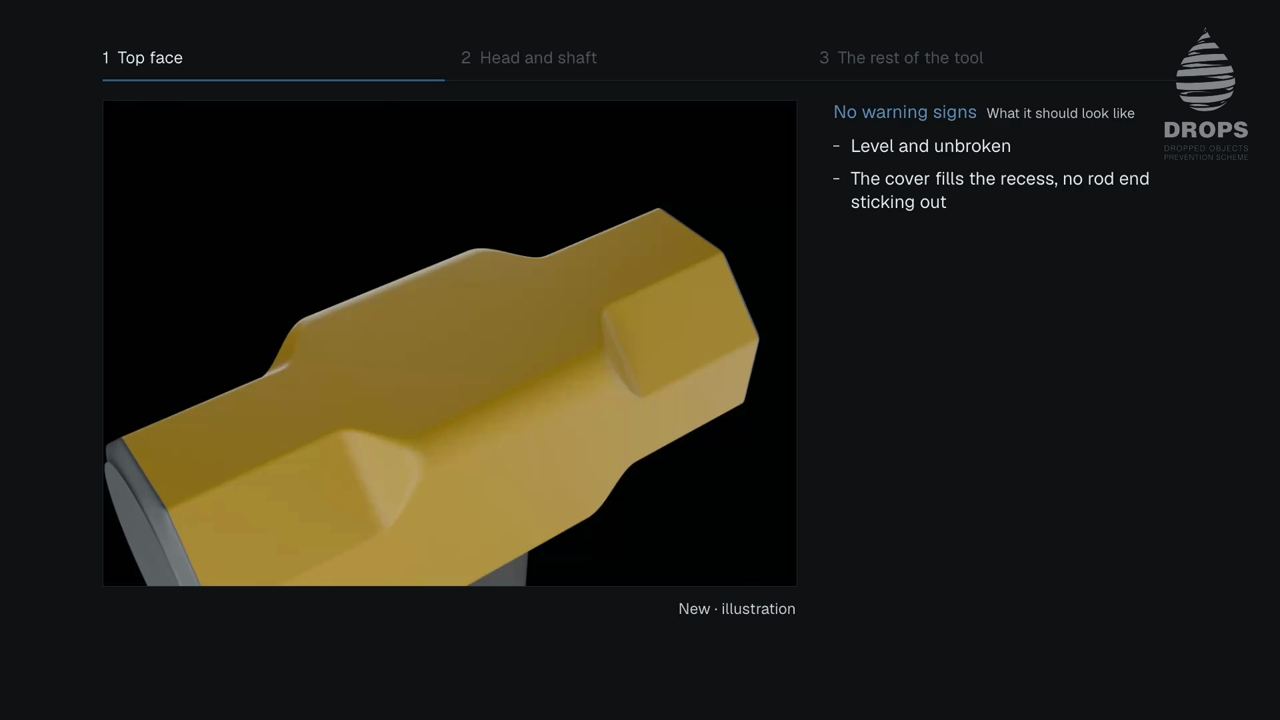 5 The check, part 19At 5:47 in the film
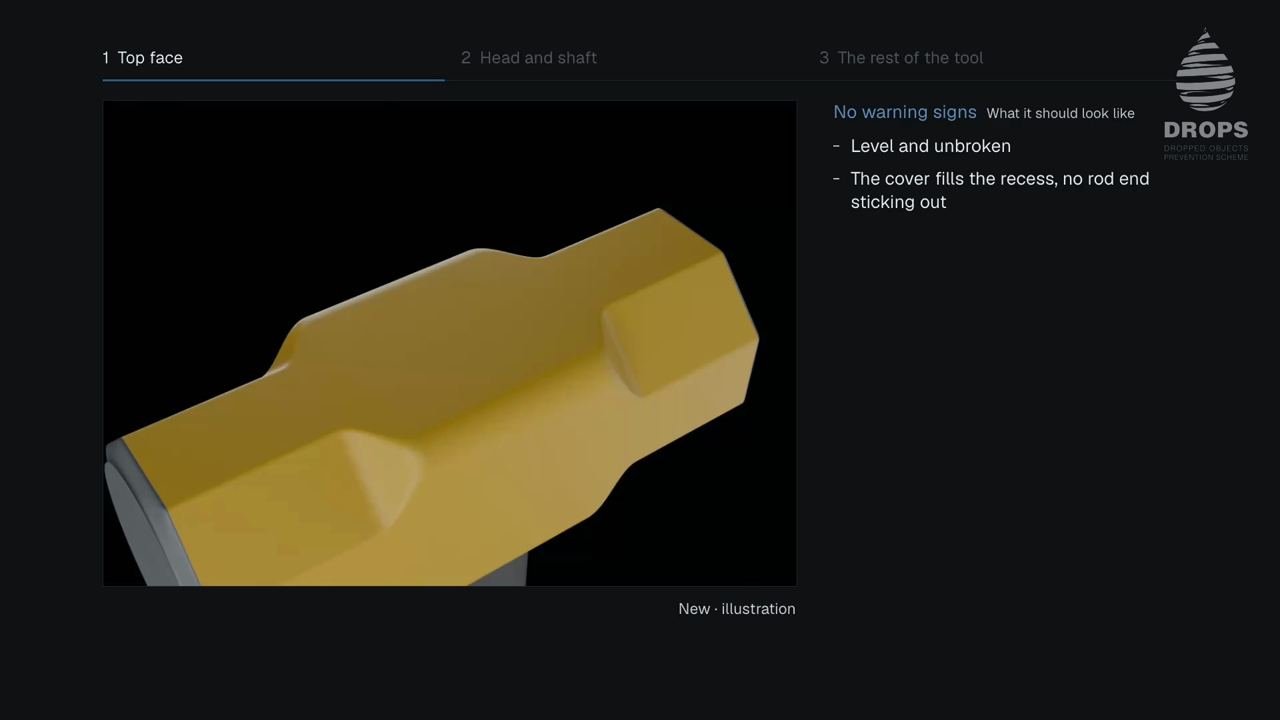 5 The check, part 21At 5:49 in the film
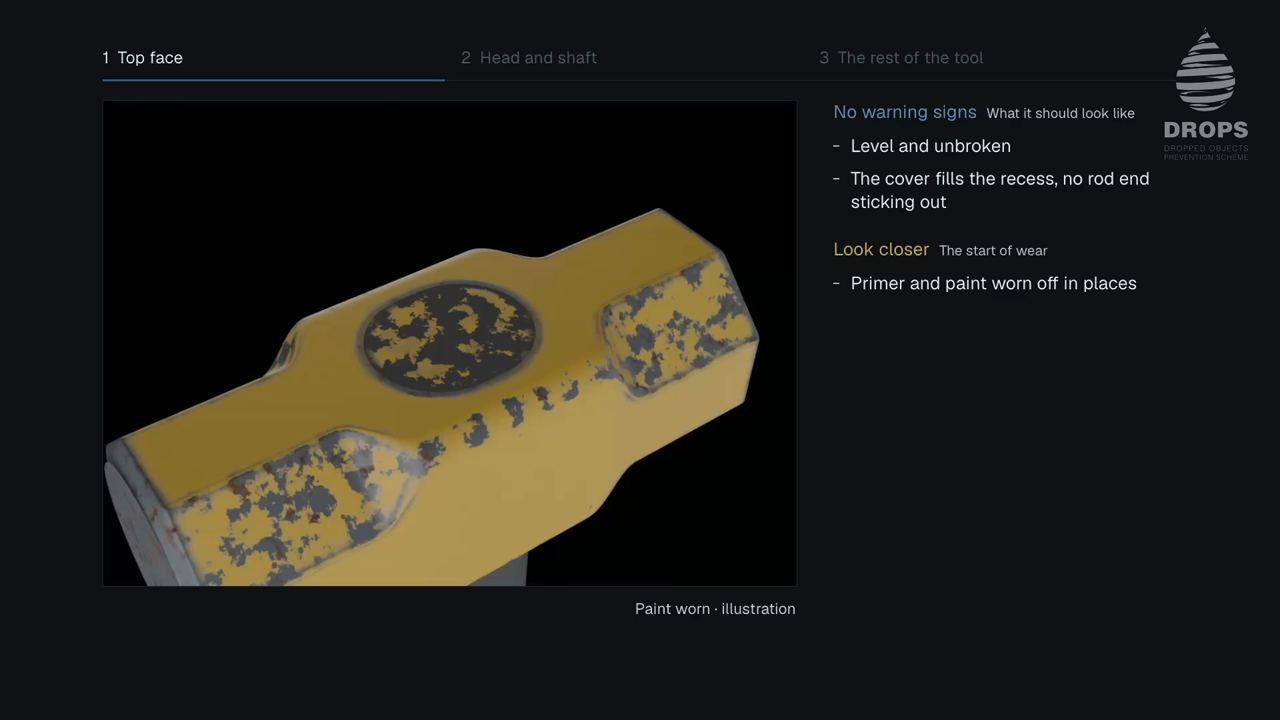 5 The check, part 23At 5:53 in the film
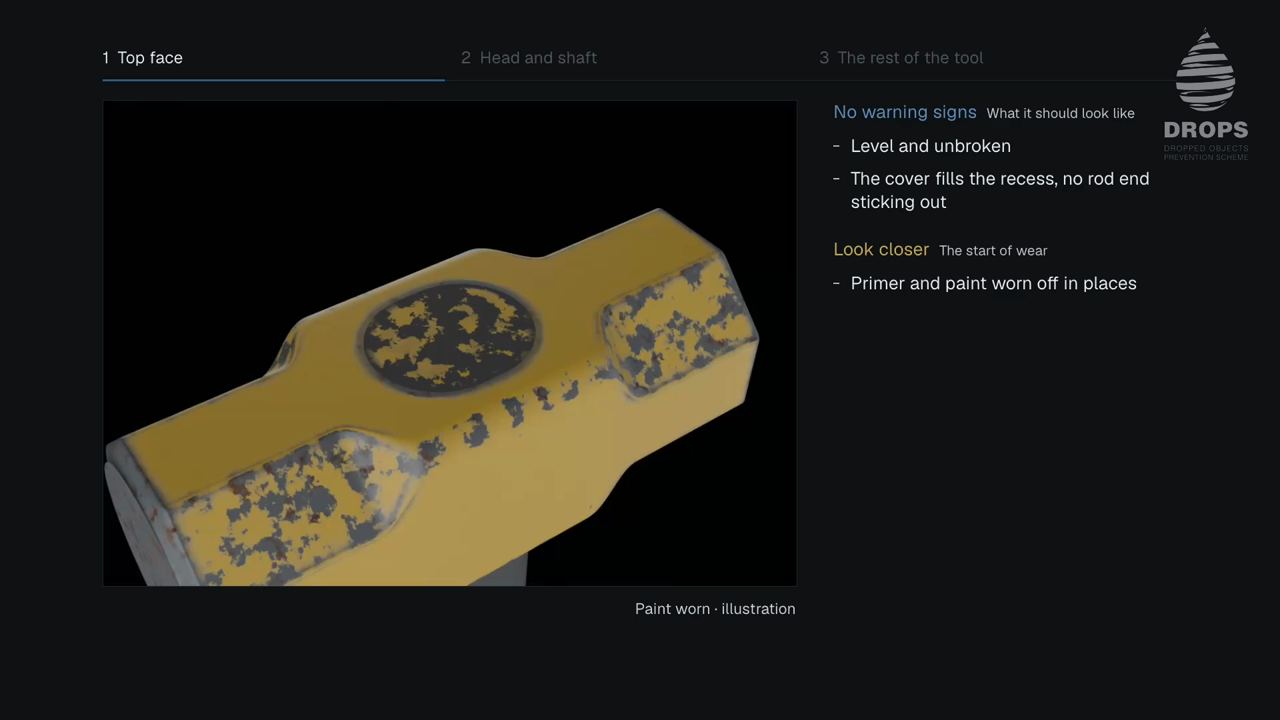 5 The check, part 25At 5:57 in the film
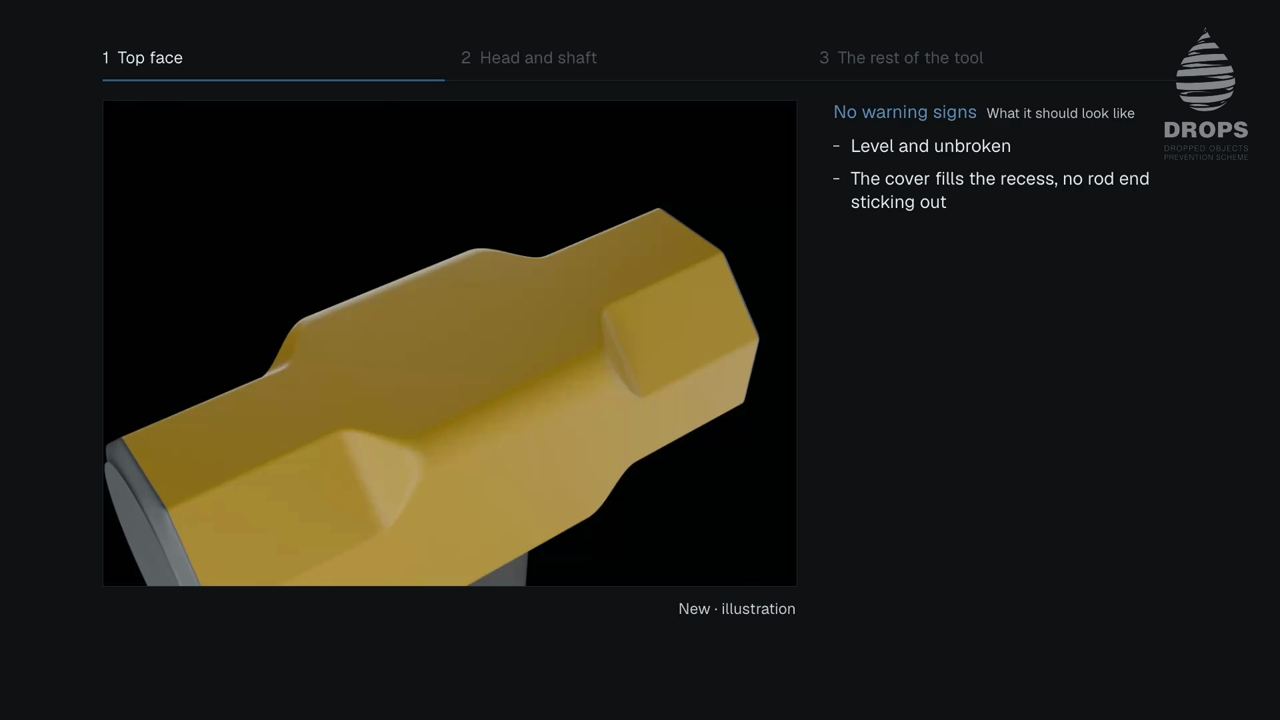 5 The check, part 27At 6:02 in the film
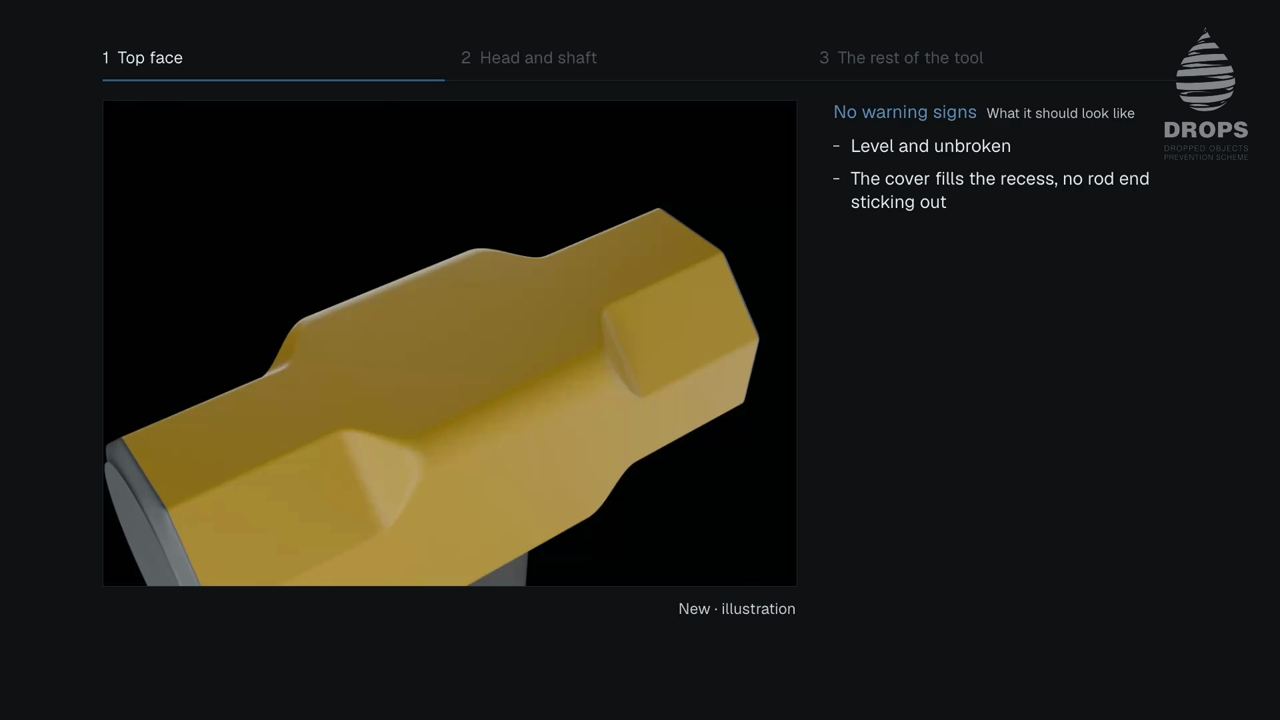 5 The check, part 29At 6:06 in the film
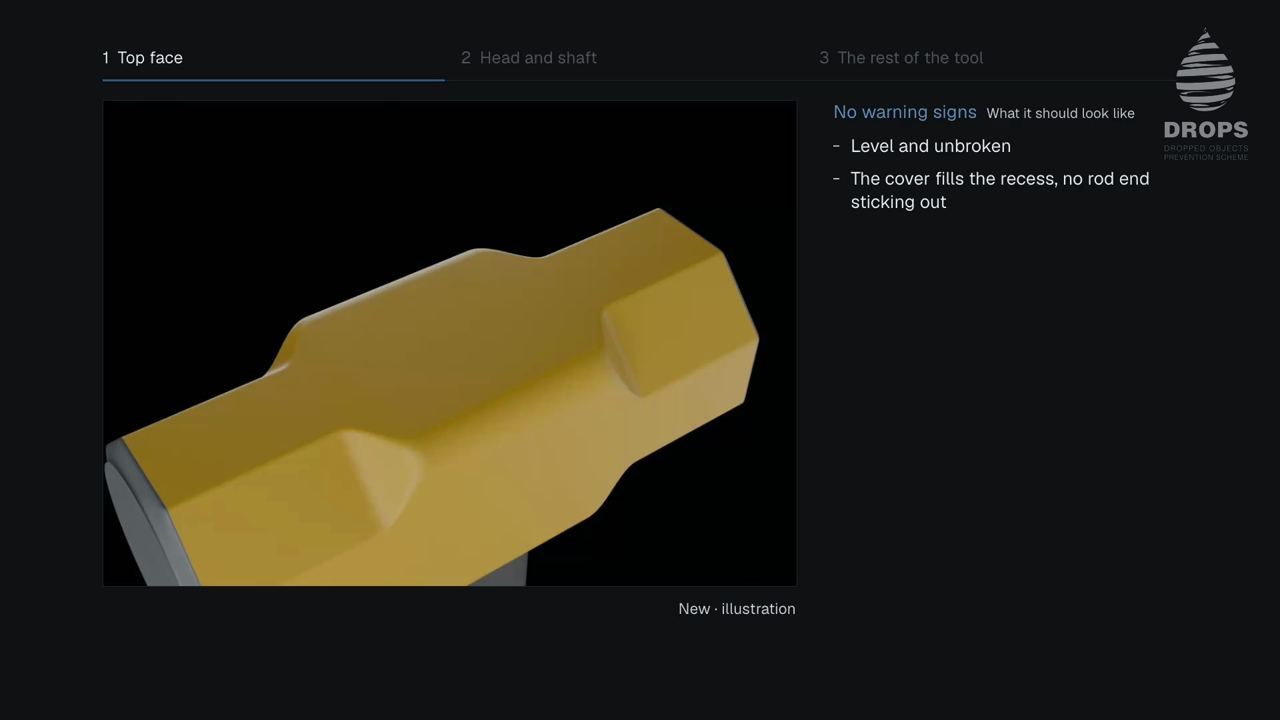 5 The check, part 31At 6:10 in the film
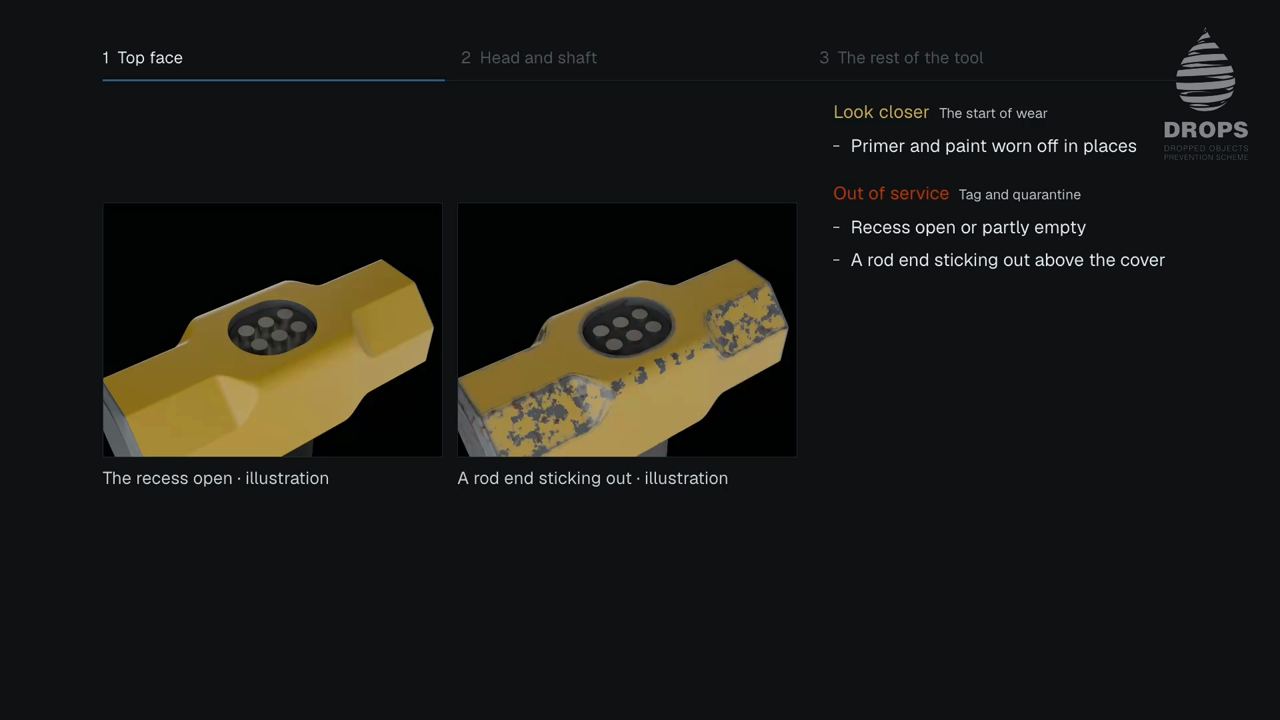 5 The check, part 33At 6:18 in the film
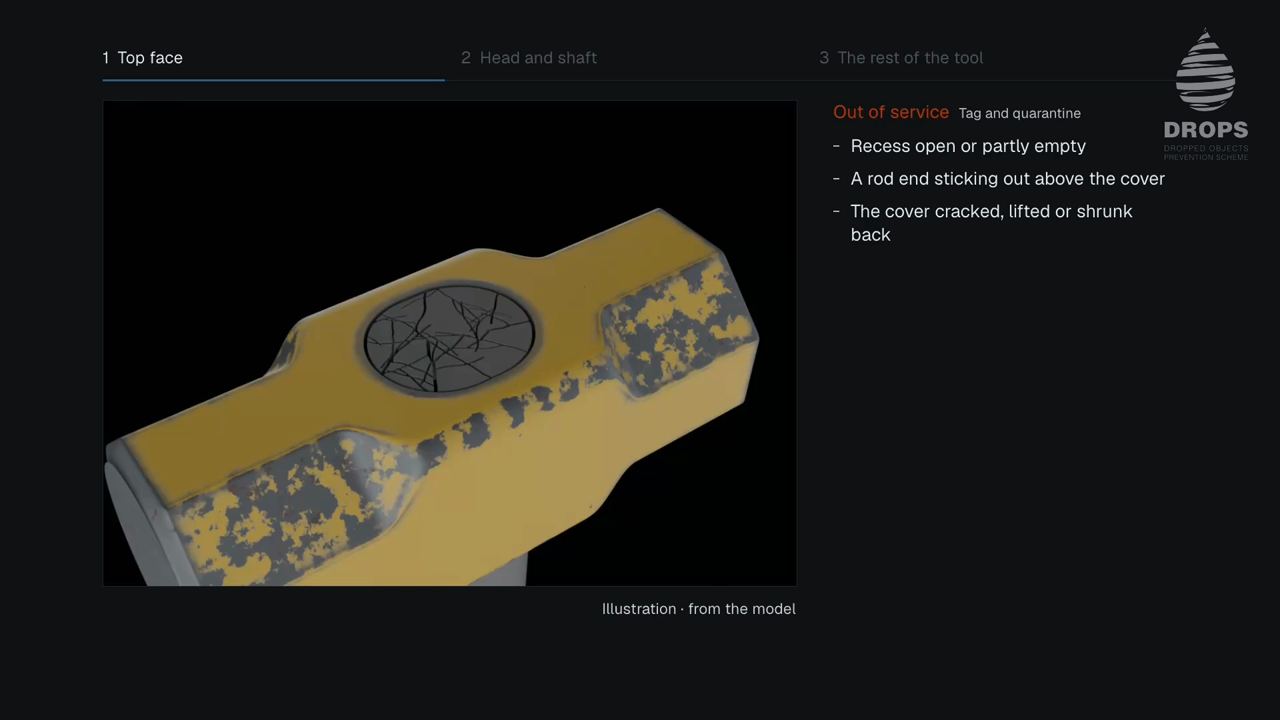 5 The check, part 35At 6:25 in the film
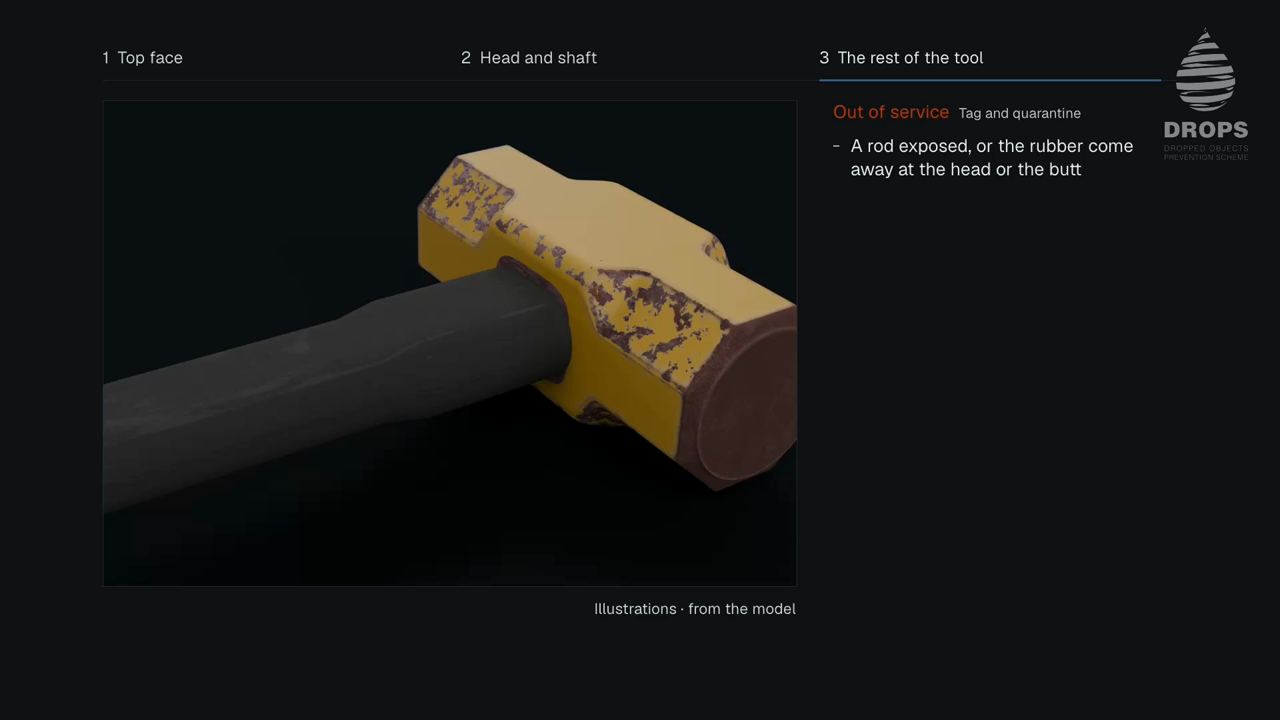 5 The check, part 47At 6:58 in the film
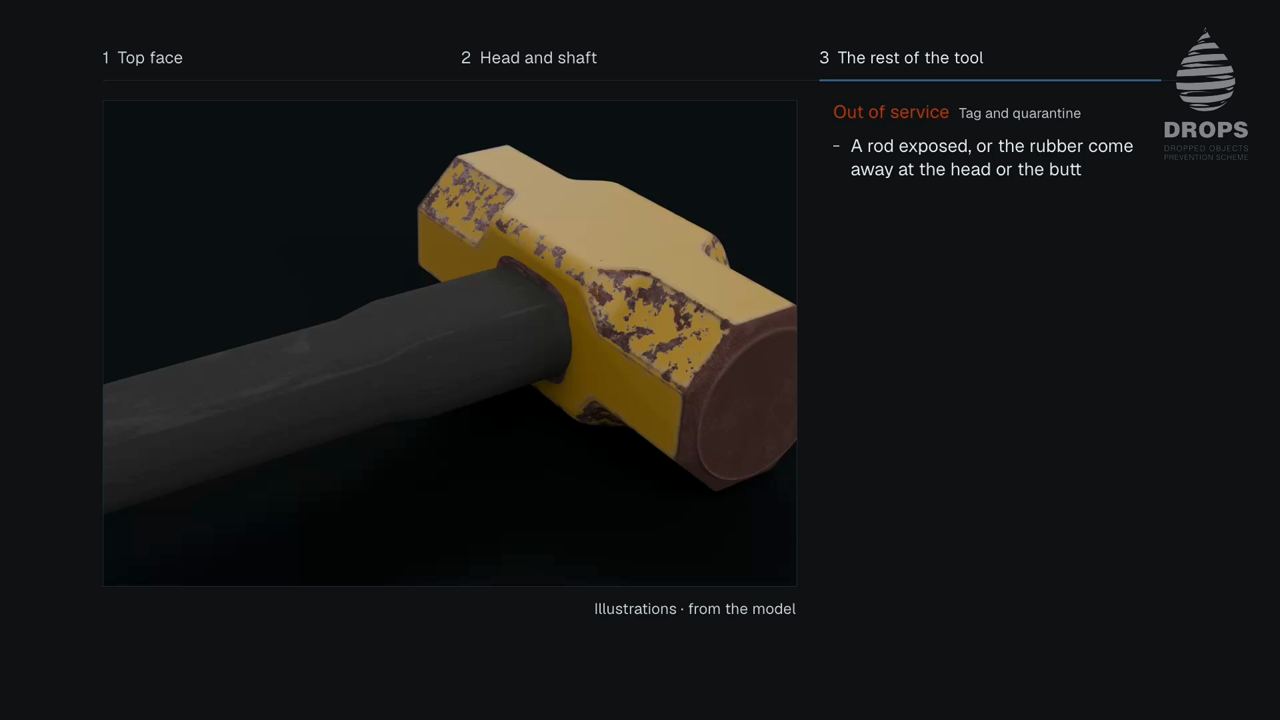 5 The check, part 49At 7:00 in the film
 5 The check, part 59At 7:31 in the film
Why: The narration and the on-screen graphics call this part the shaft instead of the handle.
What led to this
- Call the handle the shaftAdopted as proposed
Raised in 2 reviewer comments.
- New pictures
5 film stills retaken: the graphic now reads 'shoulder'.
Show the 5 stills
 2 How it is built, part 7At 1:50 in the film
 2 How it is built, part 15At 2:15 in the film
 2 How it is built, part 17At 2:20 in the film
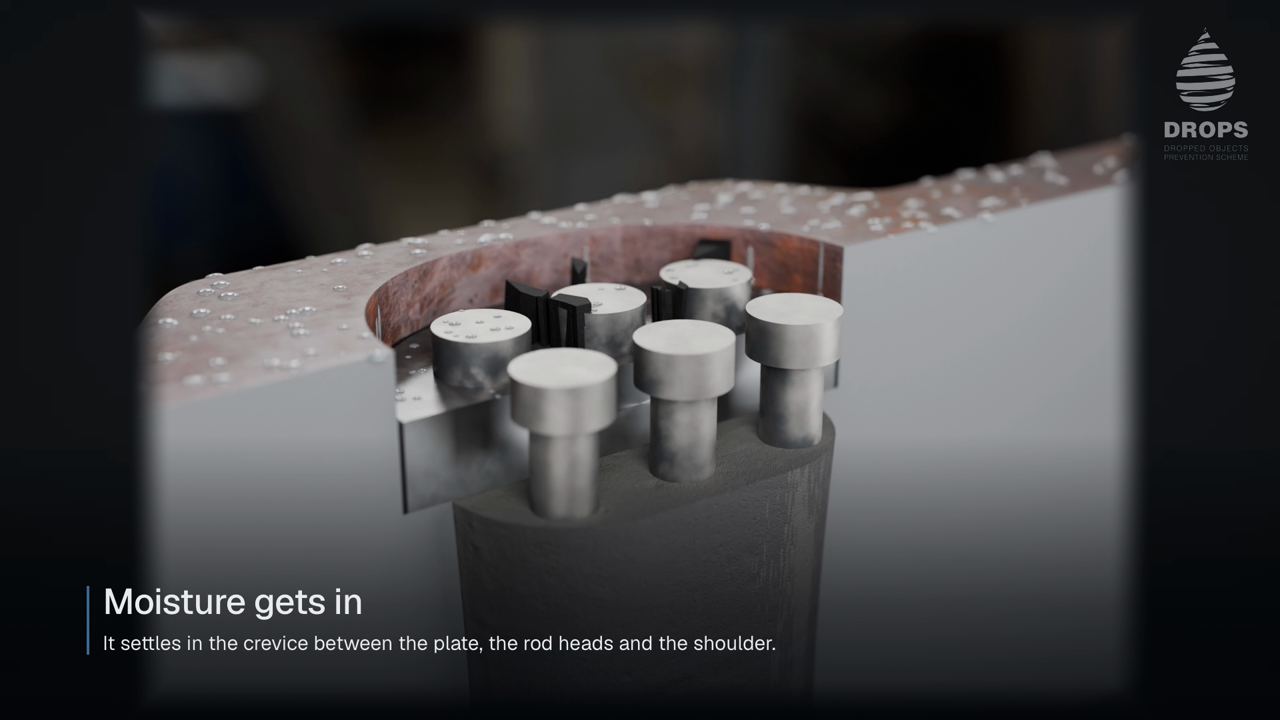 3 How it failed, part 15At 3:45 in the film
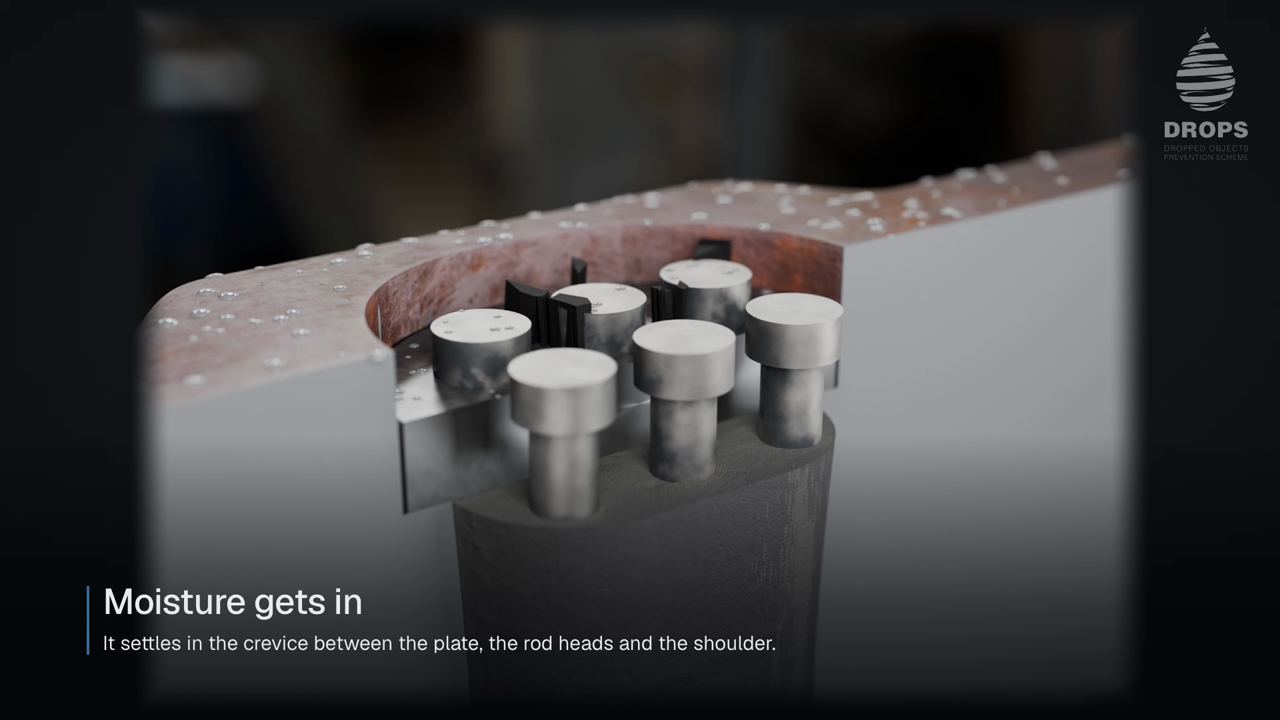 3 How it failed, part 17At 3:49 in the film
Why: The narration and graphics call the narrowing inside the head a shoulder, and say once what it is.
What led to this
- Shelf or shoulder: name the narrowing in the headAdopted as proposed
Raised in 2 reviewer comments.
- New pictures
One film still retaken: the graphic now reads 'shaft'.
Show the still
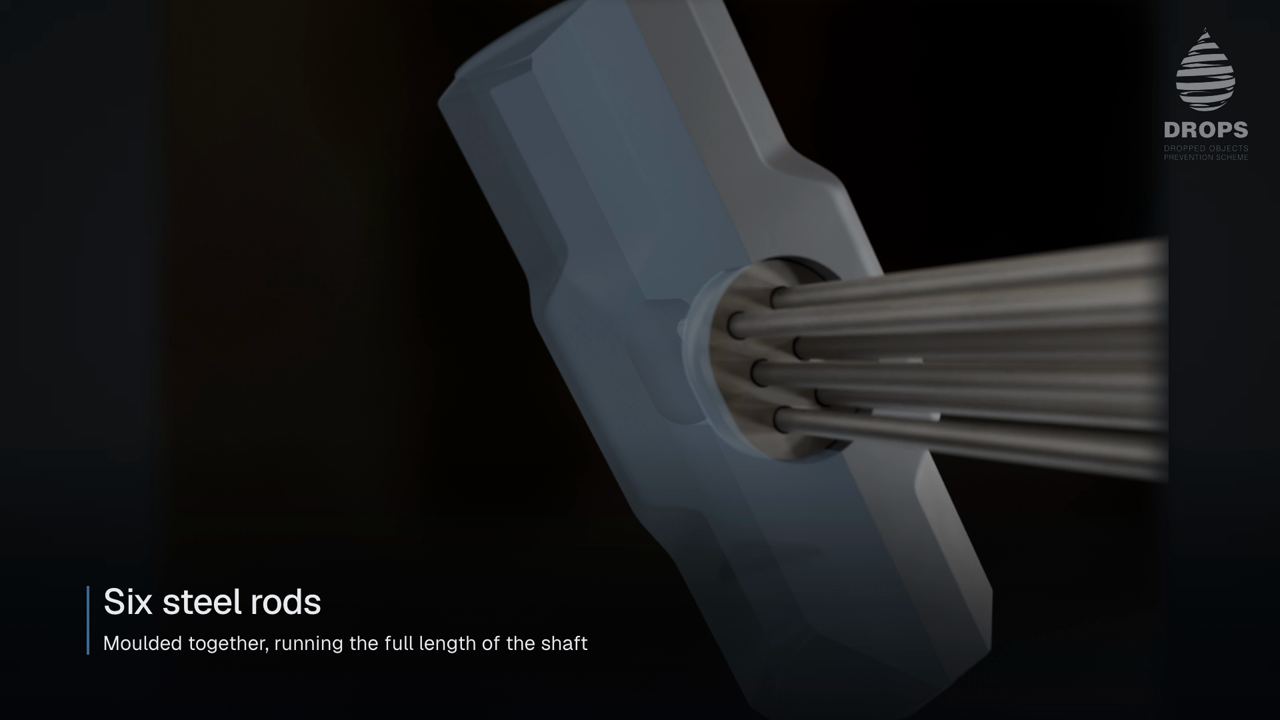 2 How it is built, part 11At 1:59 in the film
Why: The six-rod sentence uses 'shaft'.
What led to this
- Describe the shaft as a bundle of six rodsAdopted in a different form
'Handle' is now 'shaft', as you suggested. The line keeps 'moulded together' rather than 'moulded in rubber'.
Raised in 1 reviewer comment.
- New pictures
3 film stills retaken: the card now reads 'shaft' and 'Take it out of service and seek advice'.
Show the 3 stills
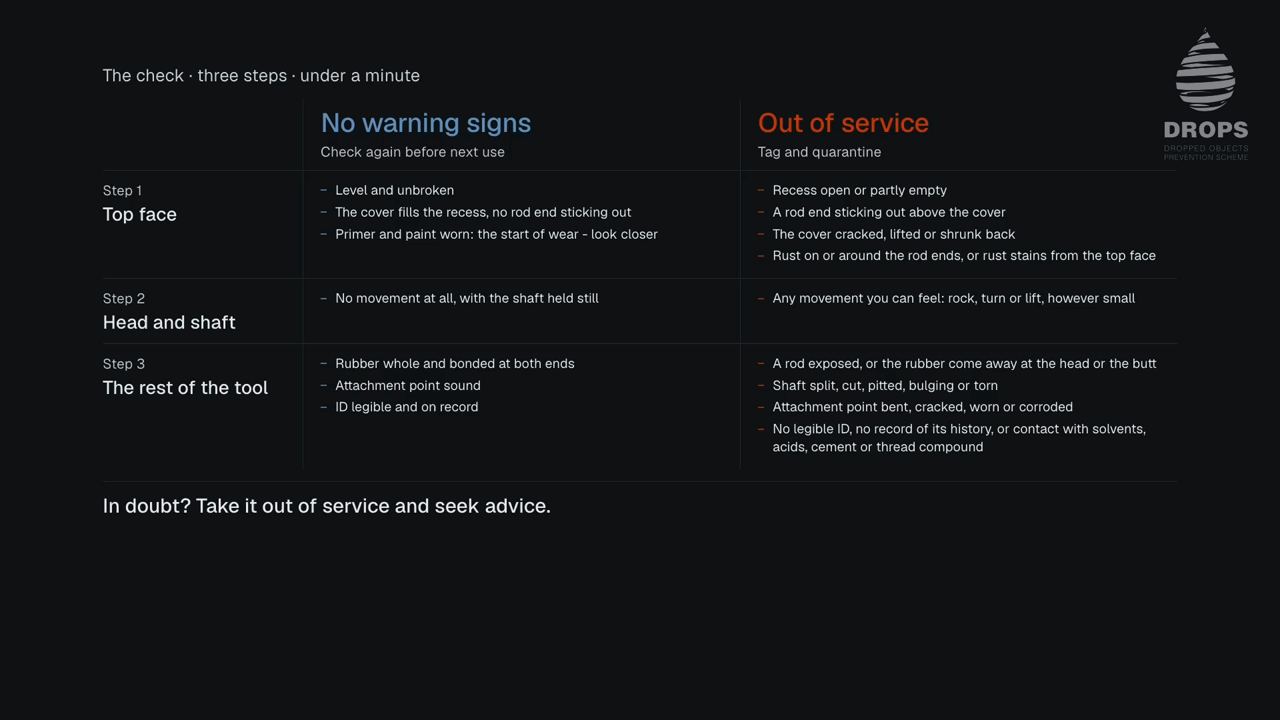 5 The check, part 61At 7:38 in the film
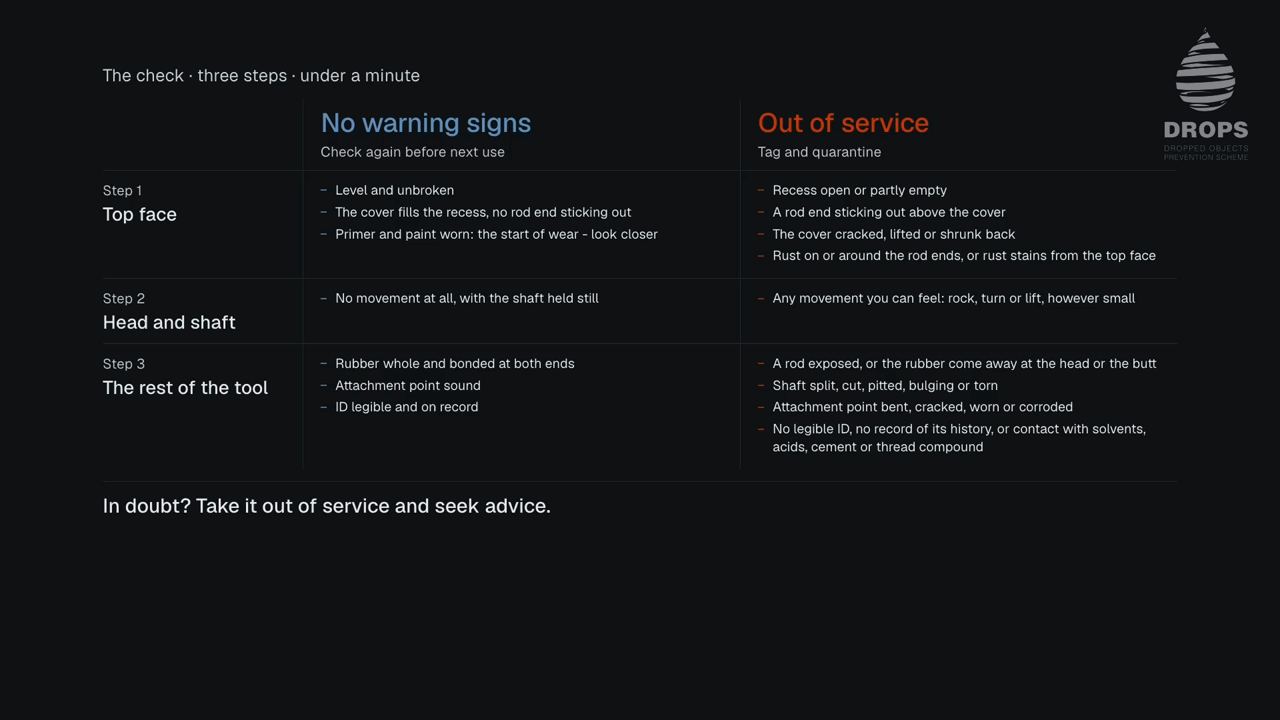 5 The check, part 63At 7:40 in the film
 5 The check, part 65At 7:44 in the film
Why: The closing instruction names who to ask.
What led to this
- Call the handle the shaftAdopted as proposed
Raised in 2 reviewer comments.
- Point to the technical authority or DROPS Focal PointAdopted as proposed
Raised in 1 reviewer comment.
Pictures and captions (2 pictures replaced, 35 captions updated)
- About this draft, part 4
Watch the film (7:30), then comment on the script below. The picture and time beside each sentence show where it falls in the film.Watch the film (7:51), then comment on the script below. The picture and time beside each sentence show where it falls in the film. 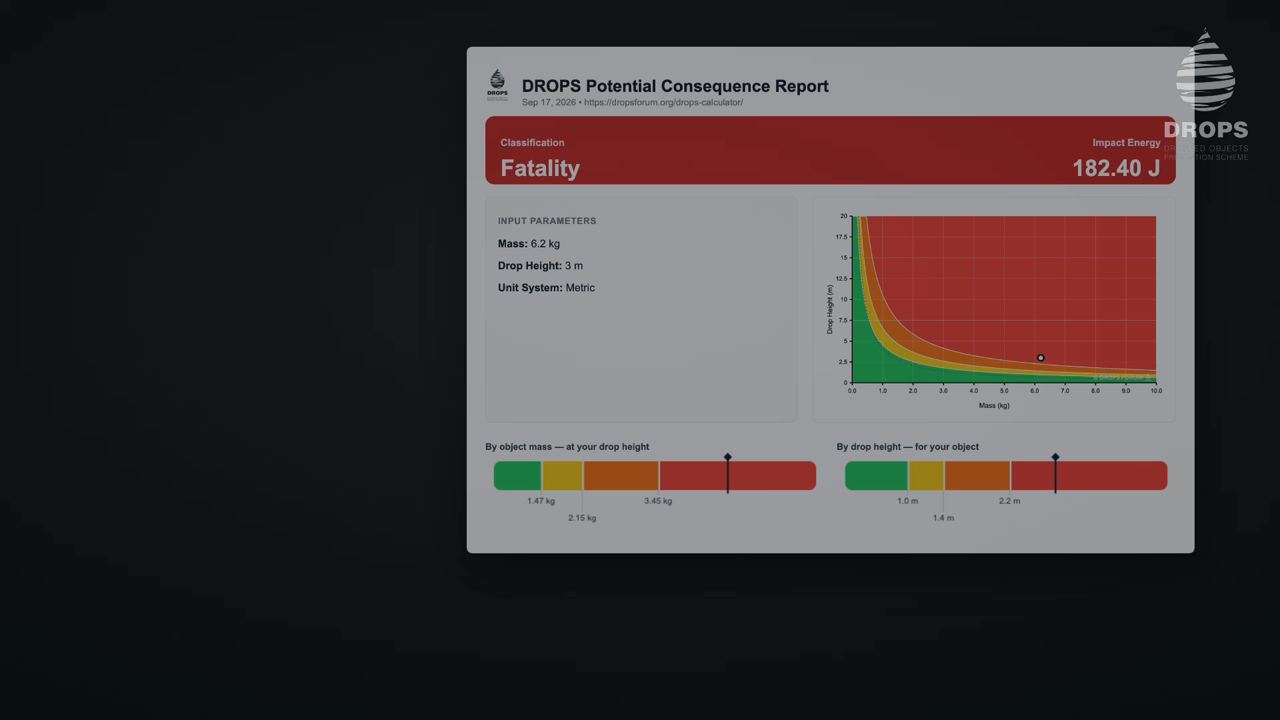
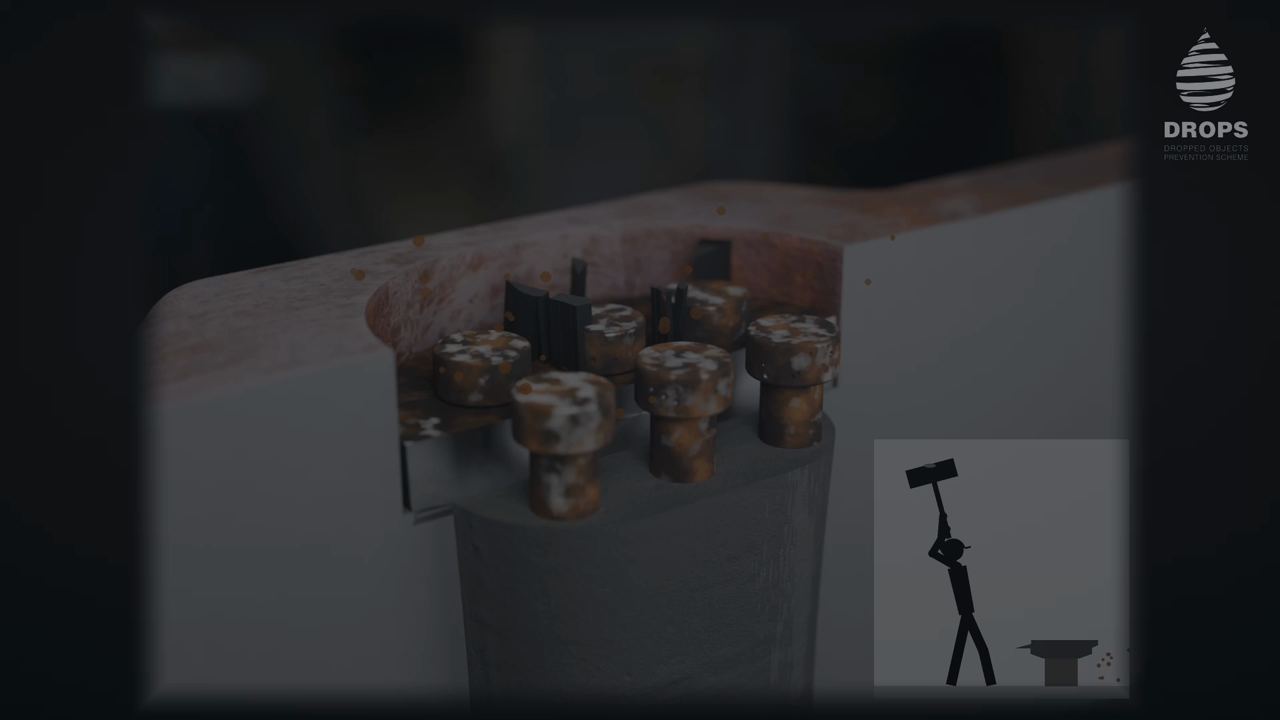
Forum comment release; LFI video script, forum draft, not yet published. Content SHA256: 305d4fe59dfd7e4a9d3e30464375095d26eb40ed01fb7253c43383590895553a
No individual changes recorded for this version.
Considered, not adopted
Suggestions the editors looked at and decided against, with the reason.
- Credit the DROPS Asia Chapter in the opening
We kept the current wording, which already says this is a learning from incident by the DROPS Asia chapter.
Raised in 1 reviewer comment.
- Say the head is secured internally
We kept the current wording, which already says the locking mechanism sits inside the head, where it cannot be seen.
Raised in 1 reviewer comment.
- Say 'this interlocking feature retains the head'
We kept the current wording, which makes the same point.
Raised in 1 reviewer comment.
- Say 'Here's the check'
We kept the current wording, which makes the same point.
Raised in 1 reviewer comment.
- Say where on each rod the steel corrodes
We kept the current wording, which already says the corrosion is worst where each rod passes through the plate.
Raised in 1 reviewer comment.
- Mention both versions of the hammer head
We decided on 23 October not to go into the different versions of this hammer in the film, so this line stays as it is.
Raised in 1 reviewer comment.
- Introduce the three-step check
We kept the current wording, which makes the same point.
Raised in 1 reviewer comment.
- Close with a simple three-step check
We kept the current wording, which makes the same point.
Raised in 1 reviewer comment.
- Say 'check the rest of the tool'
We kept the current wording, which makes the same point.
Raised in 1 reviewer comment.