
Red Zone Management
Keep people out of the line of fire — and prove it with AI-powered monitoring.
The complete guide to managing restricted access zones on drilling and industrial sites: zone classifications, area authorities, entry matrices, and the monitoring technology that turns an administrative control into a data-driven safety system.
At a glance
Control type
Administrative / isolation — protects when prevention barriers fail
Zone system
Black, Red, Yellow, and Green classifications
Why it matters
Dropped objects cause ~10% of oilfield fatalities
The frontier
AI computer vision detects intrusions in under 150 ms
Zone classifications
What is a Red Zone — and the system around it.
A Red Zone is an area where personnel may be exposed to falling objects, moving or remotely operated equipment, high-pressure equipment, and other significant hazards. Red Zones are not limited to drill floors — they apply wherever a HAZID identifies dropped object potential: crane operations, pipe decks, cargo operations, wellhead areas. Formally, these are Restricted Access Zones within a broader zone management system defined by the DROPS Recommended Practice:
Total exclusion
Black Zone
No personnel permitted at any time while the hazard is active. Hard or locked physical barricades prevent entry — for example, directly beneath a travelling block during tripping operations.
Permanent restricted access
Red Zone
A permanent barrier marks ongoing dropped-object hazards. Access only for authorized personnel with a documented risk assessment. The drill floor is the most common example.
Temporary restricted access
Yellow Zone
A temporary barrier during operations that introduce a time-limited hazard — lifting operations, certain maintenance. Tapes, chains, and signage removed when the work completes.
Open access
Green Zone
Standard workplace areas with authorized access and egress routes. Normal operational controls apply.
Every facility should maintain clearly marked zone maps showing all four classifications, with Area Authority locations, access points, and egress routes — verified by physical inspection and kept current as equipment changes alter zone boundaries.
Why it matters
Less time in hazardous zones equals fewer incidents.
The fundamental equation is simple: Red Zone Management reduces the exposure time of personnel to the highest-risk areas on any site. Industry data underscores why that matters:
10%
of oilfield fatalities are caused by dropped objects (IOGP 5-year average, 2021-2025)
35%
of 2025 fatal incidents where an IOGP Life-Saving Rule applied were 'Line of fire' — its largest category
67%
of high-potential events at Petrobras were dropped objects (2022)
<150ms
AI computer-vision detection of a zone intrusion
Fatality figures: IOGP Safety performance indicators – 2025 data (report 2025s, published June 2026).
The persistent challenge is normalized occupancy — Red Zones that are almost permanently occupied, undermining the control entirely. When exceptions become the rule, the zone system is compromised. Transocean's Red Zone Exposure Rate (RZER) metric reflects the industry's shift toward quantifying and actively reducing personnel exposure — and it is precisely why technology-enabled monitoring matters.
Best practices
Implementing Red Zone Management that holds up in practice.
An effective program combines clear ownership, current zone maps, disciplined access control, and a documented entry matrix — reviewed regularly to reduce exposure time, reposition standard operating positions, and remove people from Red Zones through automation.
Use the DROPS Calculator to quantify the consequence side of any zone risk assessment, and the hierarchy of controls to position zone management among your other barriers.
Designate Area Authorities
Every zone needs a responsible supervisor who controls access, authorizes entry, and maintains documentation — the Driller typically owns the drill floor Red Zone.
Zone maps & access diagrams
Clearly marked maps of all Black, Red, Yellow, and Green zones with Area Authority locations, access points, and egress routes — verified by physical inspection and kept current as equipment changes.
Physical barriers & signage
Barricades, chains, and warning signs (in English and the predominant local language) at all entry points, with traffic-light systems for dynamic drill-floor access control.
Permission to enter
A Task or Job Risk Assessment before any Red Zone entry, a Toolbox Talk before any Red or Yellow zone activity, and immediate withdrawal of permission on task completion.
Red Zone Entry Matrix
A documented matrix of which operations require zone entry and by whom — reviewed regularly to cut exposure time, reposition operating positions, and automate people out of the zone.
Management of Change
Permanent reclassifications go through formal MoC; temporary changes are managed by the Area Authority, who updates barriers and signage and removes them when no longer needed.
Technology-enabled monitoring
From wardens with clipboards to AI that never blinks.
Red Zone monitoring has evolved from manual verification by Red Zone Wardens and DROPS Champions — limited and prone to human error — to technology-assisted systems that are scalable, consistent, and data-driven. Modern systems combine wearable trackers, fixed-location beacons, camera-based detection, LiDAR sensors, and AI-powered analytics to provide:
- Real-time visibility of personnel in the Red Zone
- Verification of compliance with access rules and PPE requirements
- Alerts for unauthorized entries
- Automatic equipment stops when unauthorized personnel enter certain zones
- Data capture for operational analysis: occupancy patterns, exposure time tracking, and workflow optimization
| Approach | How it works | Pros | Cons |
|---|---|---|---|
| Wearable trackers / beacons | Personnel carry or wear locators (e.g. Salunda Crew Hawk, NOV HaloGuard) | Precise individual tracking; integrates with equipment controls | Device management, battery life, crew compliance |
| Camera + AI computer vision | CCTV cameras and AI algorithms detect people in defined zones | No wearables; works with existing CCTV; captures visual evidence | Needs camera coverage; lighting matters; processing power |
| Hybrid systems | Wearables + cameras + equipment integration combined | Most comprehensive coverage | Higher complexity and cost |
AI-powered monitoring — the frontier
Computer vision models like YOLO detect people in defined zones in real time — identifying boundaries, flagging intrusions in under 150 milliseconds, and operating around the clock without fatigue. The AI-in-construction-safety market is projected to reach $5.13 billion by 2030, with oil and gas a key adoption driver.
Automatic breach alerts and notifications
Occupancy tracking and exposure time measurement
Heatmaps of movement patterns and incident playback
Workflow redesign that removes people from zones entirely
The guidance
From red zones to exposure zone management.
DROPS has published zone management guidelines since 2010, and the thinking keeps evolving. The next step is exposure zone management: classifying work areas by the actual exposure of personnel to hazards — what can drop, move, or release energy, and who is in reach — rather than by fixed colors alone. Zones become dynamic: entry matrices define who may be where during which operation, and monitoring data continuously verifies that the controls reflect reality.
In this model, the zone map is a living risk picture. Exposure time becomes a measurable KPI, normalized occupancy becomes visible instead of invisible, and technology shifts from policing boundaries to redesigning work so fewer people need to cross them at all.
DROPS members are collaborating on the full Exposure Zone Management guidelines — a working draft currently under member review.
The shift in one view
Workshop & tools
Learn it hands-on, then try it yourself.
In the Red Zones & AI workshop, participants learn foundational Red Zone Management concepts and their role in the Hierarchy of Controls, examine common program weaknesses — excessive exceptions, normalized exposure, inconsistent supervision — work with AI-assisted monitoring systems including computer-vision detection, build a simplified monitoring prototype using standard cameras, and develop an implementation roadmap for their own organization. The workshop is free for DROPS members and USD 50 for non-members.
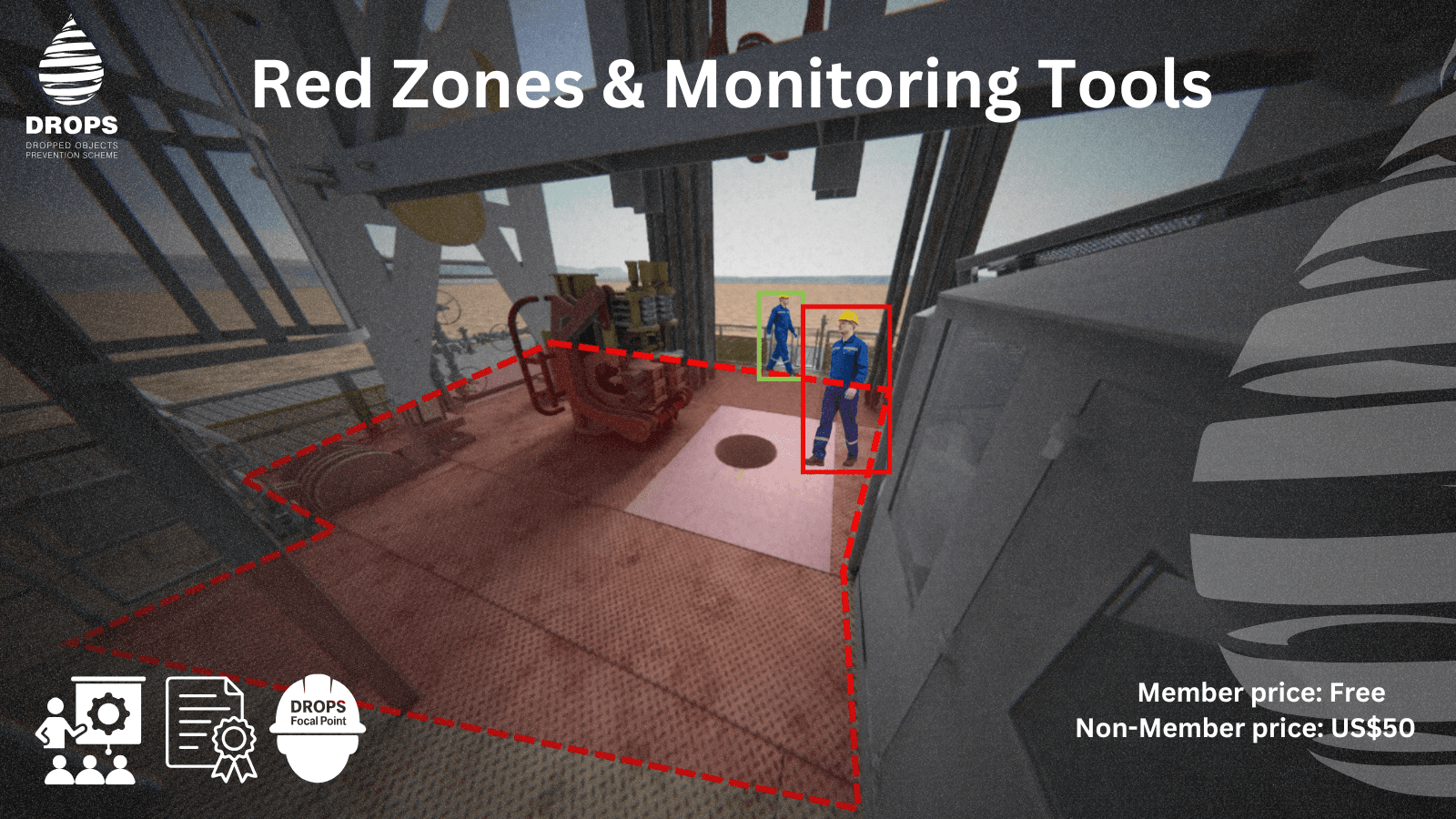
Workshop
Red Zones & AI Powered Monitoring Tools
Wed 18 Nov 7:00AM GMT
Build a working monitoring prototype with a laptop and camera. Free for members; certificate included.
Free tool
DROPS AI Monitor
A desktop app (macOS/Windows) that detects people entering a user-drawn red zone on a live camera feed, using YOLOv8 — see what AI monitoring can do before investing in commercial systems.
Download the appRecommended practice
DROPS zone management guidelines
DROPS has published industry best-practice zone management guidelines since 2010 (originally “Recommended Guidelines for the use of Restricted Access Areas (Red Zones)”). The current revision covers zone classifications, area authorities, access control, monitoring systems, entry matrices, and change management. Available to members on the learning platform.
Open the learning platformField lessons
Implementation challenges — and how to overcome them.
Some early adopters achieved impressive results; others paused deployments over misalignment, false alerts, or trust issues. The difference comes down to five things:
Policy and job design alignment
Policies often appear comprehensive on paper but create numerous exceptions in practice. Organizations must evaluate whether their Red Zone policies lead to prolonged, normalized occupancy — which defeats the purpose of zone management entirely. The recommendation: redesign workflows to minimize Red Zone time rather than just monitoring compliance with access rules.
Technology and operations alignment
A common failure is deploying technology without aligning it with operational realities. A collaborative approach between the workforce, operational leaders, and technology vendors is critical — close communication, regular feedback, and incremental adjustments ensure the system integrates into daily activities naturally.
Workforce engagement and trust
Monitoring systems should be introduced as safety and efficiency tools, not surveillance mechanisms. Clear communication, training, and workforce involvement in rollout decisions are essential. Trust accelerates adoption; a surveillance perception kills it.
Integration and scalability
Systems must integrate seamlessly with existing workflows and be scalable across different sites and challenging environments. Strong data governance is essential: address data ownership, retention periods, and privacy from the start.
Phased implementation
A staged approach is recommended: start with passive monitoring, collect data, refine policies, then progressively introduce automated alerts and enforcement. Since approximately 2016 the technology has matured significantly — modern systems offer better customization, real-time analytics, and more intuitive interfaces, shaped by early adopters’ lessons.
Getting started
Wherever you are on the journey, start here.
Whether you are establishing a Red Zone Management program for the first time or enhancing an existing one with AI-powered monitoring, DROPS Forum provides the resources and community to support the work: register for the Red Zones & AI Workshop for hands-on training including building a monitoring prototype, try the free DROPS AI Monitor to see AI-powered detection on your own camera, use the DROPS Calculator to assess dropped object risk at your facility, and access courses and recommended practices on the DROPS learning platform. For deeper capability building, the DROPS Focal Point Program covers red zone management as a core module.
Build your program with the DROPS community.
The Red Zones & AI workshop is free for DROPS Asia members, the recommended practice is on the member learning platform, and over 40 member companies share what works — and what didn't.
Red Zone Management FAQ
Red Zone Management is the systematic approach to controlling access to high-risk areas (Red Zones) where personnel may be exposed to dropped objects, moving equipment, or other hazards. It functions as an administrative/isolation control within the broader Hierarchy of Controls. The system encompasses zone classifications (Black, Red, Yellow, Green), designated Area Authorities, access control procedures, monitoring technologies, and documented entry matrices to minimize personnel exposure to hazardous areas.
A red zone monitoring system uses technology — such as cameras with AI/computer vision, wearable trackers, or sensors — to detect and track personnel entering restricted-access zones on drilling rigs and industrial sites. These systems provide real-time alerts for unauthorized entry and collect data to improve operational safety. Modern systems can detect zone intrusions in under 150 milliseconds using computer vision models like YOLO (You Only Look Once) and can operate continuously without human fatigue.
Dropped objects are responsible for an estimated 10% of fatalities in oil and gas operations. Red Zones are the areas of highest exposure to these hazards. Managing access to these zones and reducing the time personnel spend in them directly reduces the risk of injury and death. IADC 2024 data reports 956 recordable incidents, 271 lost-time incidents, and 8 fatalities across reporting contractors. At Petrobras, dropped objects accounted for 67% of high-potential events in 2022. Effective Red Zone Management addresses these risks through controlled access, monitoring, and continuous improvement.
Modern red zone monitoring systems use several types of technology: AI-powered computer vision analyzes camera feeds to detect people in defined zones in real time; wearable beacons and trackers (such as Salunda Crew Hawk or NOV HaloGuard) provide precise individual tracking and can integrate with equipment controls; LiDAR sensors offer spatial detection; and hybrid systems combine multiple approaches for comprehensive coverage. AI systems can trigger automatic alerts or equipment stops when unauthorized personnel enter restricted zones.
Start with a comprehensive HAZID/risk assessment to identify all areas requiring restricted access. Designate Area Authorities responsible for each zone. Create clearly marked zone maps showing Black (no-entry), Red (permanent restricted), Yellow (temporary restricted), and Green (open access) zones. Establish physical barriers, signage, and a permission-to-enter process requiring documented risk assessments. Implement a Red Zone Entry Matrix to track which operations require zone entry. Consider technology-enabled monitoring using camera-based AI detection or wearable trackers. Use a phased approach: start with passive monitoring, collect data, refine policies, then progressively introduce automated alerts and enforcement.
Exposure zone management is the evolution of traditional red zone management: instead of relying on fixed color-coded zones alone, work areas are classified by the actual exposure of personnel to hazards — what can drop, move, or release energy, and who is within reach during which operation. Zones become dynamic, governed by entry matrices, and continuously verified with monitoring data, so exposure time becomes a measurable KPI rather than an invisible habit. DROPS members are developing full Exposure Zone Management guidelines, currently in working-draft review.