
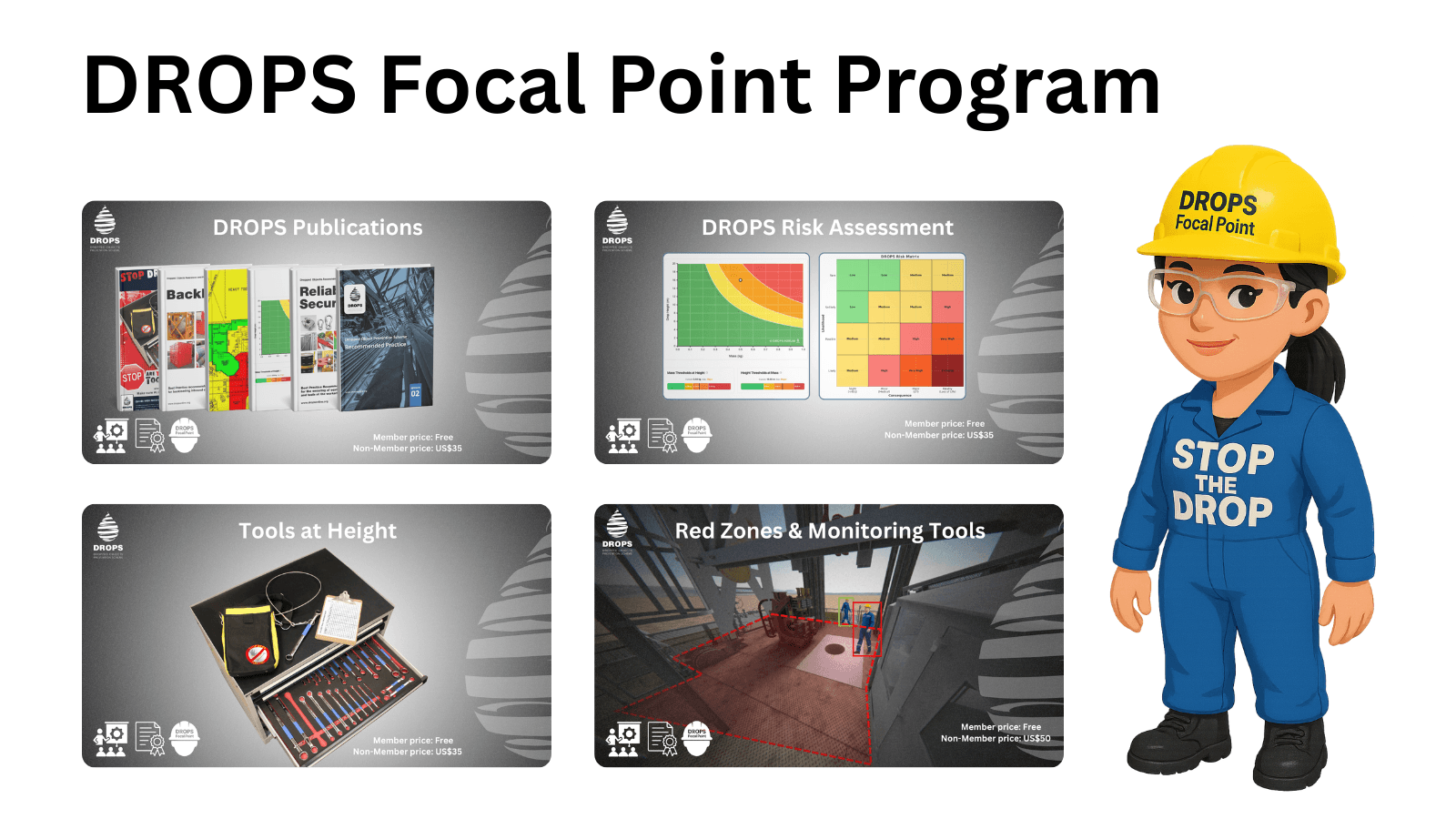
DROPS Focal Point Program
Build certified dropped-object leadership inside your organisation.
Workshops, assignments, mentoring, and examinations that turn designated leads into DROPS Focal Points — the people who own dropped-object hazard management and make prevention stick.
Built for member companies · individual workshops open to all
At a glance
Duration
6–18 months, depending on specialization
Format
Modular workshops — take them in any order
Recognition
Module certificates issued today — full certification opens 2027
Full programme
DROPS Asia member companies — up to 5 employer-nominated seats
Non-members
Welcome at any individual workshop, from US$35
The pathway
Four stages from shared language to certified capability.
The program rebuilds a deep understanding of dropped-object hazard management step by step. Implementation is immediate — participants apply what they learn as they progress instead of waiting until the end.
01
Basics
Establish a common language and dropped-object hazard awareness across your team.
02
Fundamentals
Build core capability through modular workshops — reliable securing, inspections, risk assessment, red zones, audits, and governance.
03
Specialization
Deepen expertise in areas you choose: vendor management, inspector program design, human factors, KPIs, or AI-enabled monitoring.
04
Certification
Full certification — a fundamentals exam plus a specialization project at a live site — opens in 2027. Module certificates are issued today.
What you learn
Fundamentals that cover the whole dropped-object lifecycle.
Most fundamentals are delivered through regularly scheduled workshops that can be taken in any order. After each module, participants complete a short test and receive a module certificate.
Specializations then deepen expertise where your operation needs it most — contracts and vendor management, inspector program design, human factors, performance and KPIs, solution development, and optional AI-enabled monitoring.
DROPS Recommended Practice
The structure and requirements of the DROPS Recommended Practice — and how to apply it across your operation.
Reliable securing
Primary and secondary retention and proven securing methods for equipment and structures at height.
Tools at height
Tool management, tethering, and practical controls for work at height across drilling and industrial operations.
Inspections & evidence
Inspection program design, evidence standards, action tracking, and close-out discipline.
Risk assessment
Consequence and likelihood assessment, barriers versus controls, and building a tailored risk matrix.
Red zone management
Exclusion zone design, access control, and modern AI-assisted monitoring approaches.
Learning from incidents
Investigations, incident alerts, and turning lessons into lasting controls.
Audits & governance
Ownership models, audit design, logistics interfaces, and program governance that lasts.
Programme modules
Take the modules your operation needs, in any order.
Each module is a live workshop with its own certificate, so capability is built a session at a time rather than by blocking out months. Modules repeat roughly every two to three months. New modules are added as the programme grows.
Fundamentals
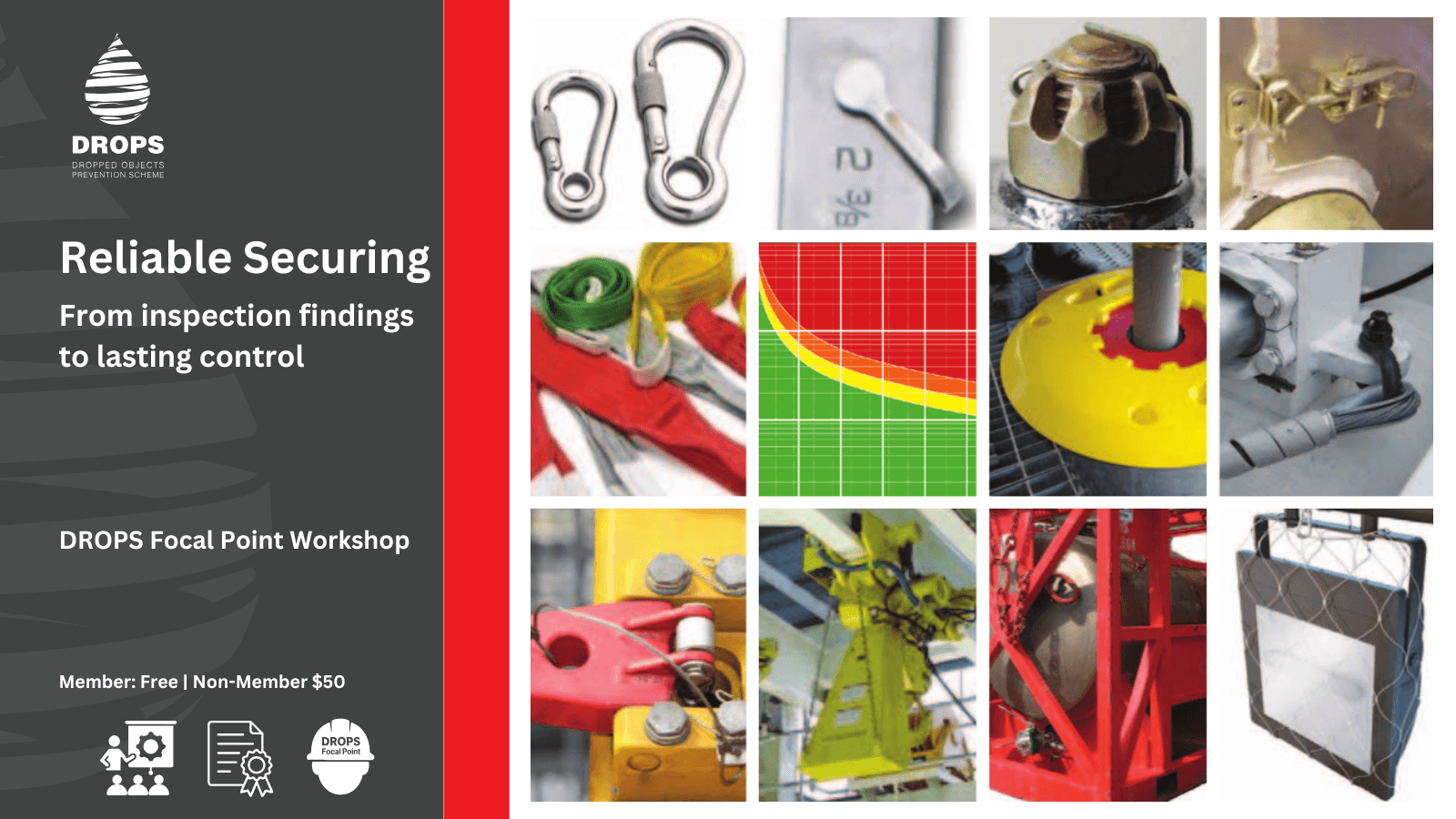
Reliable Securing
Mon 19 Oct 7:00AM GMT
Members free · Non-members US$50
Show details
Fundamentals
Reliable Securing
Mon 19 Oct 7:00AM GMT
Members free · Non-members US$50
A practical DROPS Focal Point Workshop on recognizing weak securing, distinguishing primary fixing, secondary retention and safety securing, and converting findings into lasting controls.
- Cost
- Members free · Non-members US$50
Fundamentals
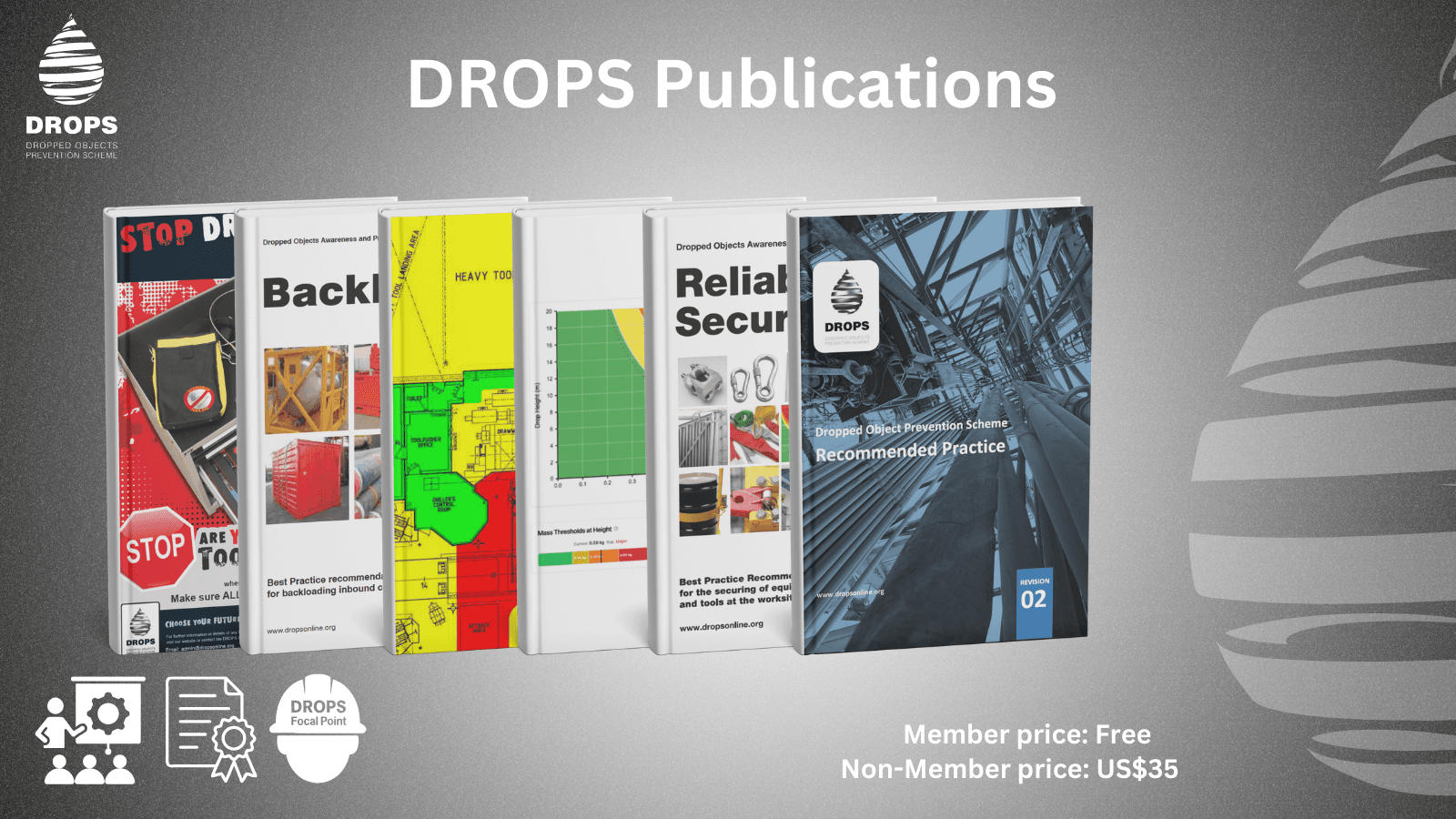
DROPS Recommended Practices
Tue 20 Oct 7:00AM GMT
Members free · Non-members US$35
Show details
Fundamentals
DROPS Recommended Practices
Tue 20 Oct 7:00AM GMT
Members free · Non-members US$35
Introduction to the DROPS Recommended Practices. Its intended purpose and limitations
- Cost
- Members free · Non-members US$35
- Certificate
- Issued when you pass the module test
Fundamentals
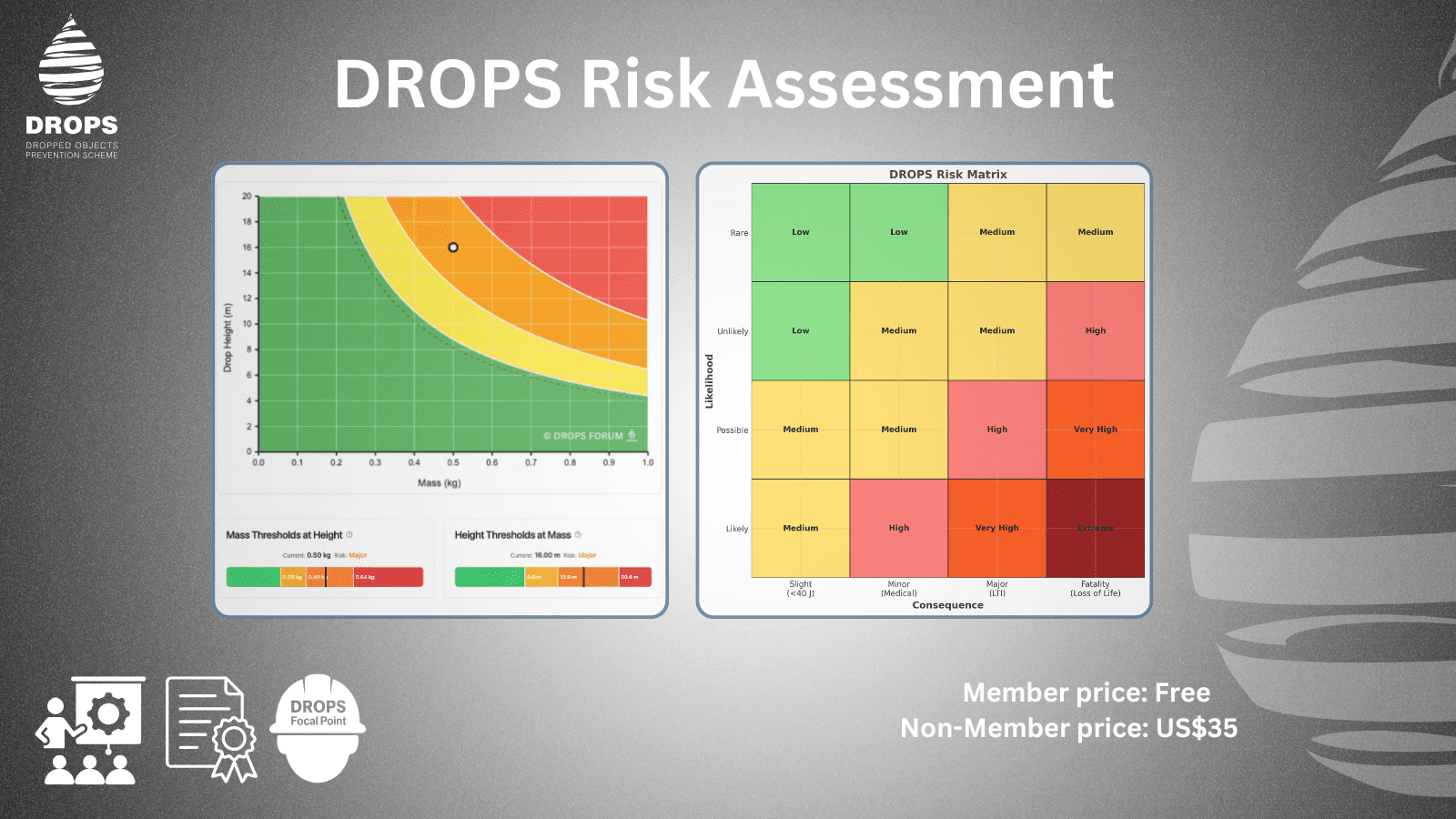
Risk Assessment for DROPS
Mon 26 Oct 7:00AM GMT
Members free · Non-members US$35
Show details
Fundamentals
Risk Assessment for DROPS
Mon 26 Oct 7:00AM GMT
Members free · Non-members US$35
Risk Assessment using the DROPS Calculator and Likelihood
- Cost
- Members free · Non-members US$35
- Certificate
- Issued when you pass the module test
Fundamentals
Tools at Height
Tue 27 Oct 7:00AM GMT
Members free · Non-members US$35
Show details
Fundamentals
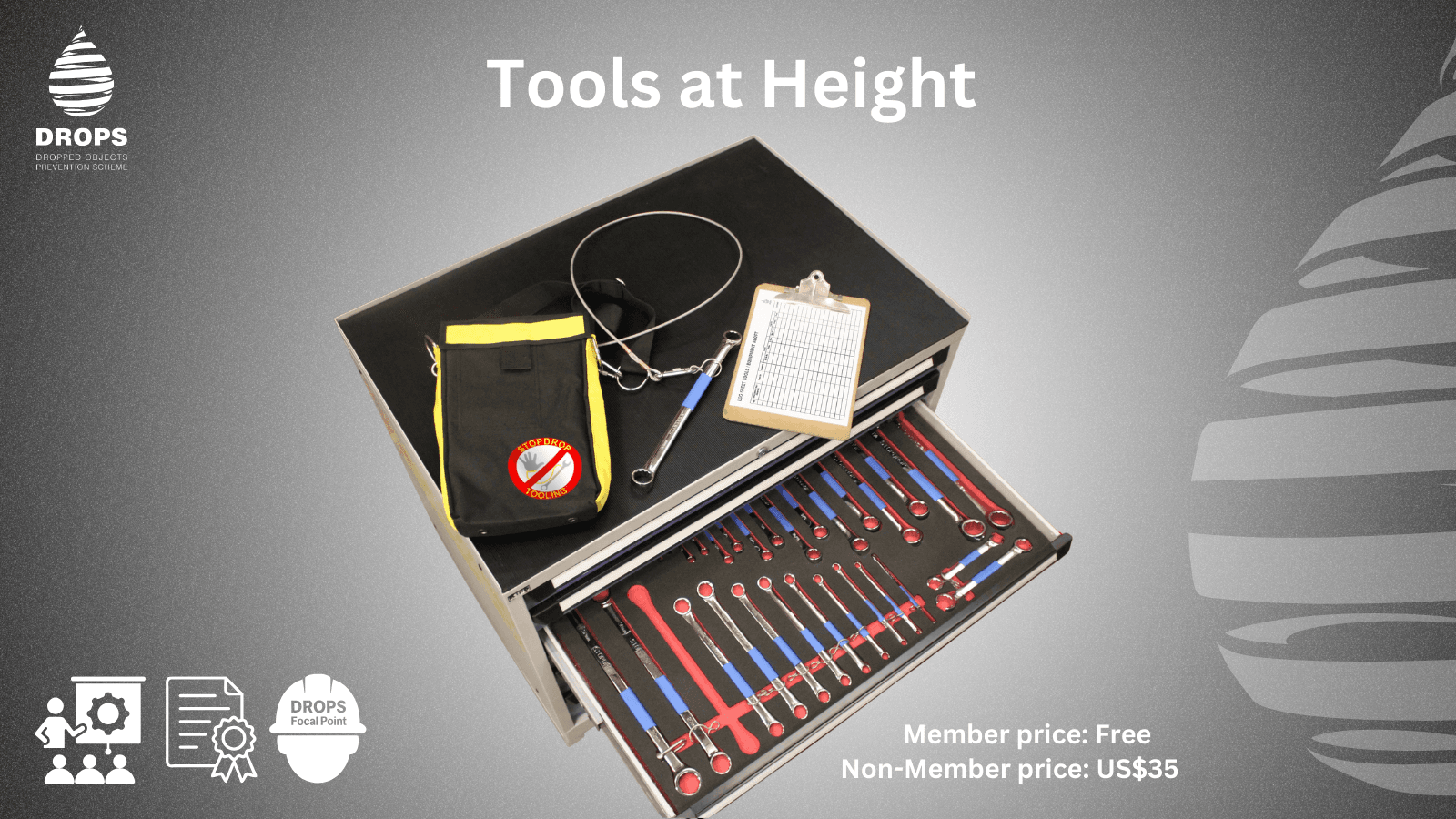
Tools at Height
Tue 27 Oct 7:00AM GMT
Members free · Non-members US$35
Practical guidance on applying the DROPS Recommended Practice for safe use of tools and equipment at height, with scenarios, certification, and e-learning enrolment.
- Cost
- Members free · Non-members US$35
- Certificate
- Issued when you pass the module test
Fundamentals
Managing Independent Dropped Object Surveys
Tue 17 Nov 7:00AM GMT
Members free · Non-members US$50
Show details
Fundamentals
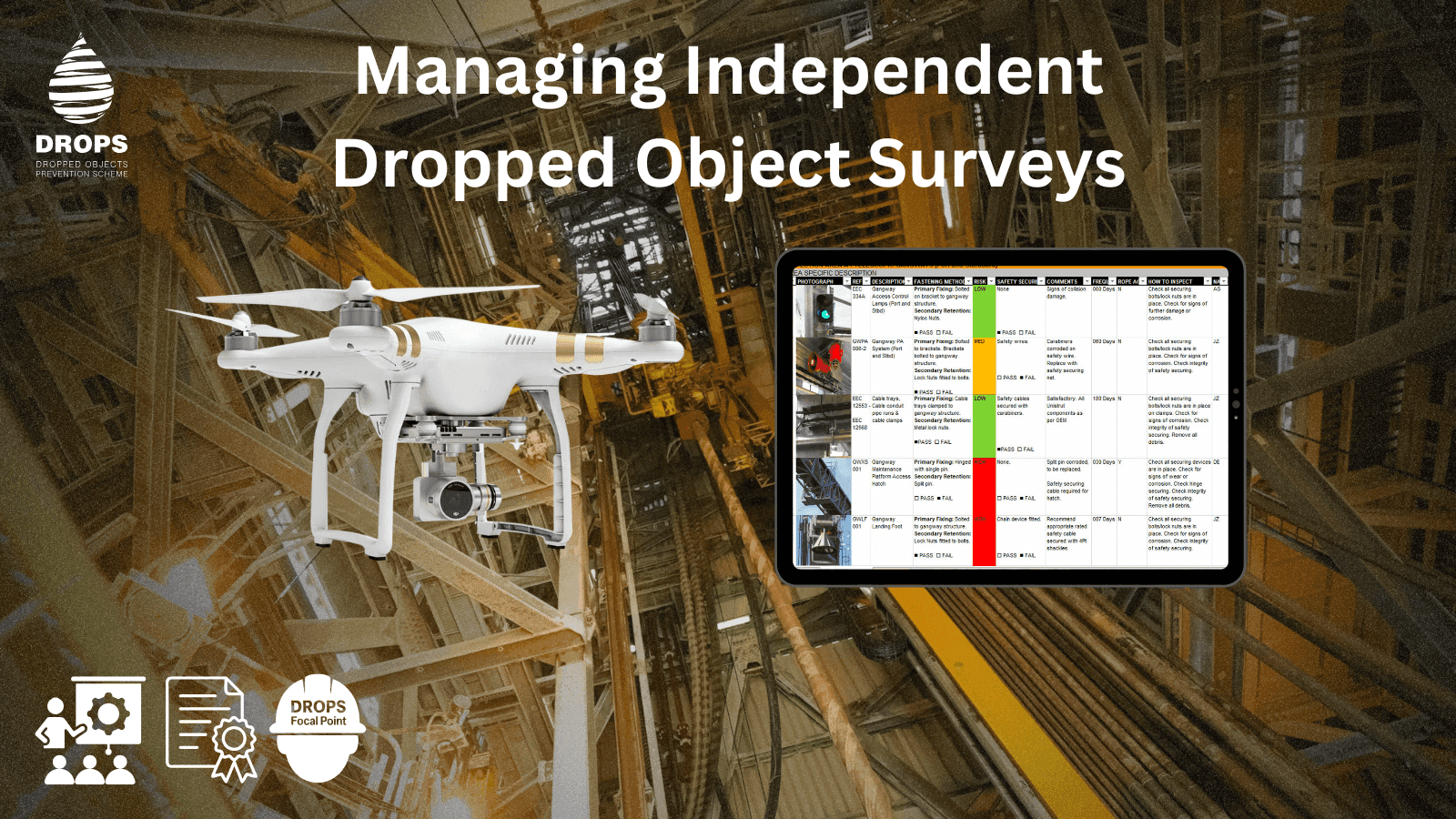
Managing Independent Dropped Object Surveys
Tue 17 Nov 7:00AM GMT
Members free · Non-members US$50
A management-focused workshop examining how Independent Dropped Object Surveys fit within the wider DROPS programme. The session explores provider selection, competency, inspections versus auditing, use of technology, and common misunderstandings between asset owners, operators, and inspection companies, with the aim of improving assurance value and dropped object risk control.
- Cost
- Members free · Non-members US$50
- Certificate
- Issued when you pass the module test
Fundamentals
Red Zone Management & Monitoring with AI
Wed 18 Nov 7:00AM GMT
Members free · Non-members US$50
Show details
Fundamentals
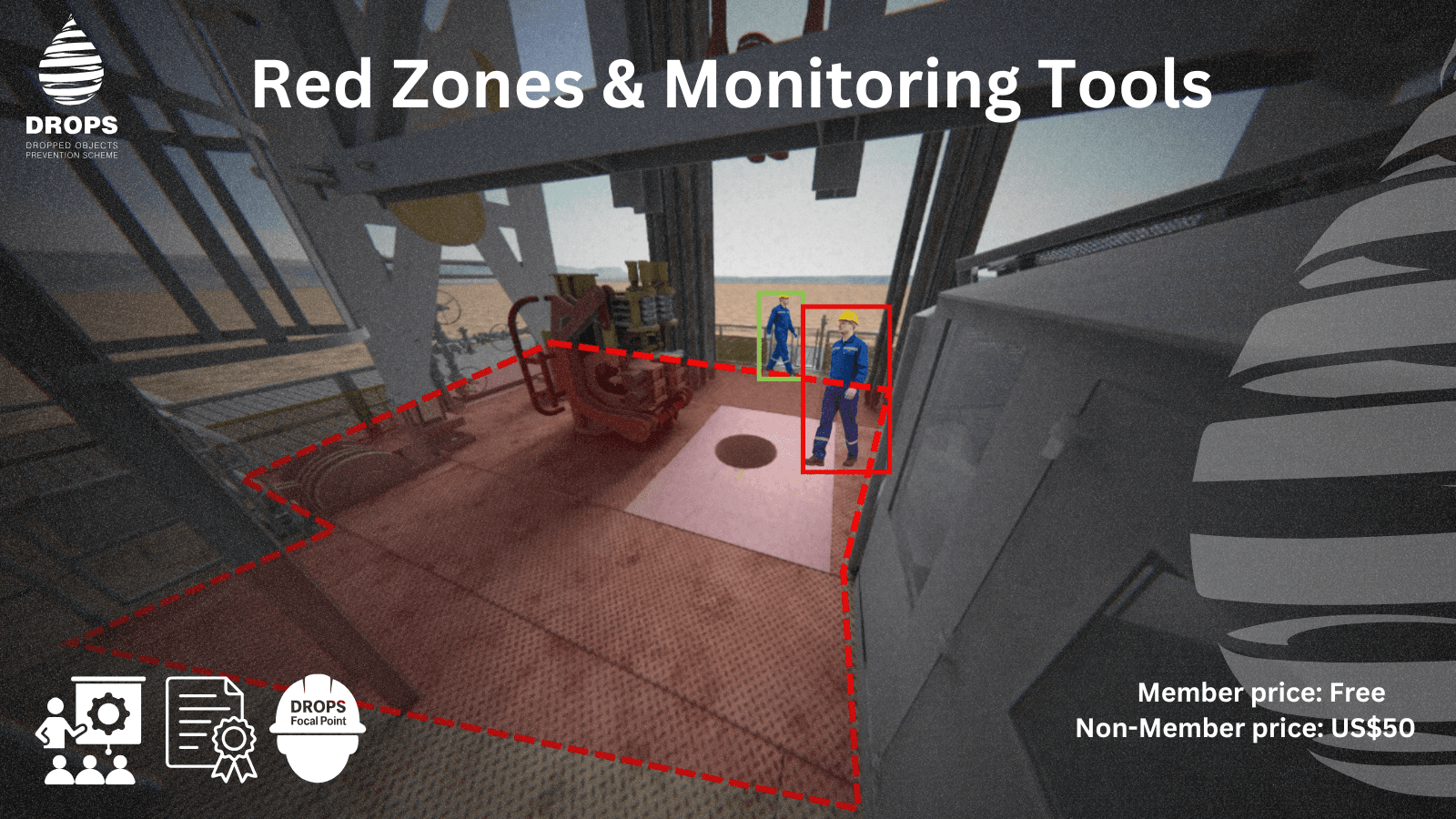
Red Zone Management & Monitoring with AI
Wed 18 Nov 7:00AM GMT
Members free · Non-members US$50
A workshop on modern Red Zone Management and AI-assisted monitoring, designed for DROPS focal points and safety leaders, with hands-on learning and certification.
- Cost
- Members free · Non-members US$50
- Certificate
- Issued when you pass the module test
Basics
DROPS Snakes & Ladders
Open anytime
Free
Show details
Basics
DROPS Snakes & Ladders
Open anytime
Free
Play the DROPS Snakes & Ladders learning game and complete the certificate exam.
- Cost
- Free
- Certificate
- Issued when you pass the module test
In development
Module 8
Topic to be announced
In development
Module 9
Topic to be announced
Outcomes
Graduates leave with a deployable focal point playbook.
A certificate is issued for every module you complete. From 2027, full certification will additionally be validated through a fundamentals exam and a specialization project demonstrating measurable risk reduction at a live site — not just attendance.
A role charter defining the focal point mandate inside your organisation
Inspection and action plans ready to deploy
Contractor bridging clauses and vendor acceptance checks
A tailored risk matrix and control map for your operation
A KPI set to measure and demonstrate risk reduction
Why the full programme runs through membership.
The programme is built to help a company put its own dropped-object hazard management in place — assignments are carried out on your assets, with your data, and coached against your operation. That is work we can only do properly alongside a member company, which is why the full programme runs through membership and is free to DROPS Asia Chapter members, up to 5 participants each.
Individual workshops are a different matter — anyone is welcome at those, member or not, and each one earns its own certificate.
Enrol
Ready to start? Access the program.
If your company is a DROPS Asia member, log in with your work email to open the programme, track your modules and collect certificates as you go — up to 5 participants per company, free of charge. If it is not a member yet, you can still book any individual workshop above.
How enrolment works
- 1
Log in with your work email
A secure one-time code — no password to remember.
- 2
Open the Focal Point Program
Enrol into the course and see the full module pathway.
- 3
Learn and get certified
Take modules in any order, complete short tests, and collect certificates as you go.
Focal Point Program FAQ
Program access (members only): The full DROPS Focal Point Program is open only to DROPS Asia Chapter members. For the 2026 rollout, participation is capped at five (5) participants per member company; this cap will likely be reduced over time. Module tests and certificates are included at no additional cost.
For more information about membership, visit our membership page.
Individual workshops (non‑member access): Non‑members may attend individual workshops for a nominal fee of USD 10–50 per session, subject to availability. (Pricing is posted per session.)
Purpose & outcome
Focal Point Program: Builds a program owner who coordinates inspections, drives action closure, aligns contractors/vendors, designs site‑specific risk matrices, and reports to leadership.
Train‑the‑Trainer (TTT): Builds instructional capability to deliver awareness/fundamentals training, toolbox talks, and assessments to crews at scale.
Primary audience
Focal Point: HSE/operations leads or technical leads responsible for DROPS governance and performance.
TTT: Instructors, supervisors, or safety practitioners tasked with delivering and evaluating training.
Scope of skills
Focal Point: Governance, inspection scope/quality, evidence standards, action tracking and verification, consequence×likelihood risk assessment, bridging/contract clauses, KPI design and leadership reporting.
TTT: Course delivery and facilitation, scenario practice, adapting materials to site context, creating/marking quizzes, measuring learning outcomes, coaching crews.
Duration & verification
Focal Point Program: Minimum six (6) months with multiple workshops and assignments; typically 6–18 months depending on specialization. Verification is knowledge‑ and application‑based (per‑module tests and graded assignments).
Train‑the‑Trainer: One‑time, half‑day course. Verification is attendance‑based (certificate of attendance).
Depth & learning model
Focal Point Program: Goes deeper into each topic with applied assignments and coaching; understanding is verified through tests and deliverables.
Train‑the‑Trainer: Assumes participants will invest time after the half‑day course to develop deeper subject understanding and build their own site training program; no program‑led deep dives or verification beyond attendance.
Broad outline
Basics: Shared language and roles; core DROPS concepts and hazard types.
Fundamentals: Reliable securing and inspections; evidence standards; consequence + likelihood risk; barriers/controls and exclusion zones; action closure and performance reporting.
Specializations: Pathways such as inspector development, vendor/contract management, engineered solutions/containment, human factors, and digital tools/analytics.
2026 collaboration The 2026 rollout will be co‑designed and fine‑tuned with member companies. Syllabi, examples, and module sequencing will be adjusted based on participant feedback and operational needs. New topics may be added, and depth will vary by sector and risk profile.
Short answer: It can be a pathway, but formal inspector sign‑off must come from a specialized inspection company.
How the pathway works
Specialize: Choose the Advanced Inspector track within the program. Complete the advanced modules, scenarios, and assessments.
Foundation modules: Serve as core training material and should be completed early; they establish baseline knowledge (reliable securing, inspections & evidence, risk, barriers/controls) that the inspector track builds on.
Employer sponsorship: Your company commits to the pathway (time allocation and asset access).
Inspection company partnership: A specialized inspection company mentors/assesses you and provides final sign‑off.
Mentored fieldwork: Work under an experienced inspector, carrying out a range of inspections (derrick, cranes, overheads/structures, laydown, logistics). Keep a logbook with photo evidence, part IDs, torque/verification data, and reports.
Competency evidence: Pass module tests, complete applied assignments, and present your logbook for competency review by the inspection company.
What we provide
Foundation module content as the base training library, plus structured advanced curriculum, checklists and evidence standards, defect grading guidance, and practice cases.
Coaching and feedback on field assignments; mock inspections and case reviews.
Reading list and templates (registers, action trackers, KPI snapshots) to support your logbook and reviews.
What is required from you
Significant self‑study (standards, OEM bulletins, incident alerts) and regular practice in the field.
Consistent evidence quality and close‑out discipline.
Bottom line
The program prepares and guides you toward inspector readiness, but qualification depends on partnership with a specialized inspection company, mentored experience, and demonstrated field competence.
Fundamentals run on fixed dates and repeat at least once every two months. A recommended sequence is provided for coherence, but it is not mandatory—modules may be taken in any order. Each workshop begins with a brief recap of essential foundations so participants can join at any time.
Basic awareness is recommended prior to taking any fundamentals and must be completed before completing the fundamentals section of the program.
Most of the advanced modules will have prerequisites.
Dates are posted on a rolling calendar and additional runs are opened based on demand.
Short answer: Yes.
Fundamentals: Offered as standalone workshops you can take in any order (a recommended sequence is provided but not mandatory). Each session includes a short test; a pass earns a module certificate and counts toward program completion. Fundamentals run at least once every two months, with a brief foundations recap at the start so you can join at any time.
Specializations: Delivered in cohorts and typically require selected Fundamentals first. These are not designed for single‑session pick‑and‑choose; enroll in the full run (missed topics can be taken in the next cohort).
Access & fees: The full program is members‑only (cap of five participants per company during rollout). Non‑membersmay attend individual Fundamentals for a nominal fee (USD 10–50 per session), subject to availability; member companies have priority on seats.
Short answer: For the full program, no—enrollment is employer‑sponsored and limited to member companies. Individuals from non‑member companies cannot enroll in the full program.
Program purpose (why sponsorship is required): The primary goal is to train people who can design, run, and continually improve an organization’s dropped‑object hazard management program, especially where large workforces are exposed to potential dropped objects. That capability requires on‑the‑job assignments, access to assets and data, and organizational support—hence employer nomination.
If your company is a member: Ask your employer to nominate you. During the 2026 rollout, seats are capped at five participants per company; priority goes to members, with a waitlist if sessions fill.
If your company is not a member: You may attend individual Fundamentals workshops as standalone sessions for a nominal fee (USD 10–50 per session, subject to availability). These earn module certificates but do not place you in the full program unless a member company later sponsors you.
Independent consultants: Join through a member company (as their nominated focal point) or have your firm become a member to access the full program.