
Risk Assessment for DROPS
Risk Assessment using the DROPS Calculator and Likelihood
Date & Time
Mon 26 Oct 3:00PM GMT+8 to Mon 26 Oct 4:00PM GMT+8
Cost
Member: USD 0.00
Non-Member: USD 35.00
Risk Assessment Tools for DROPS: Foundations, Likelihood, and Hands-On Application
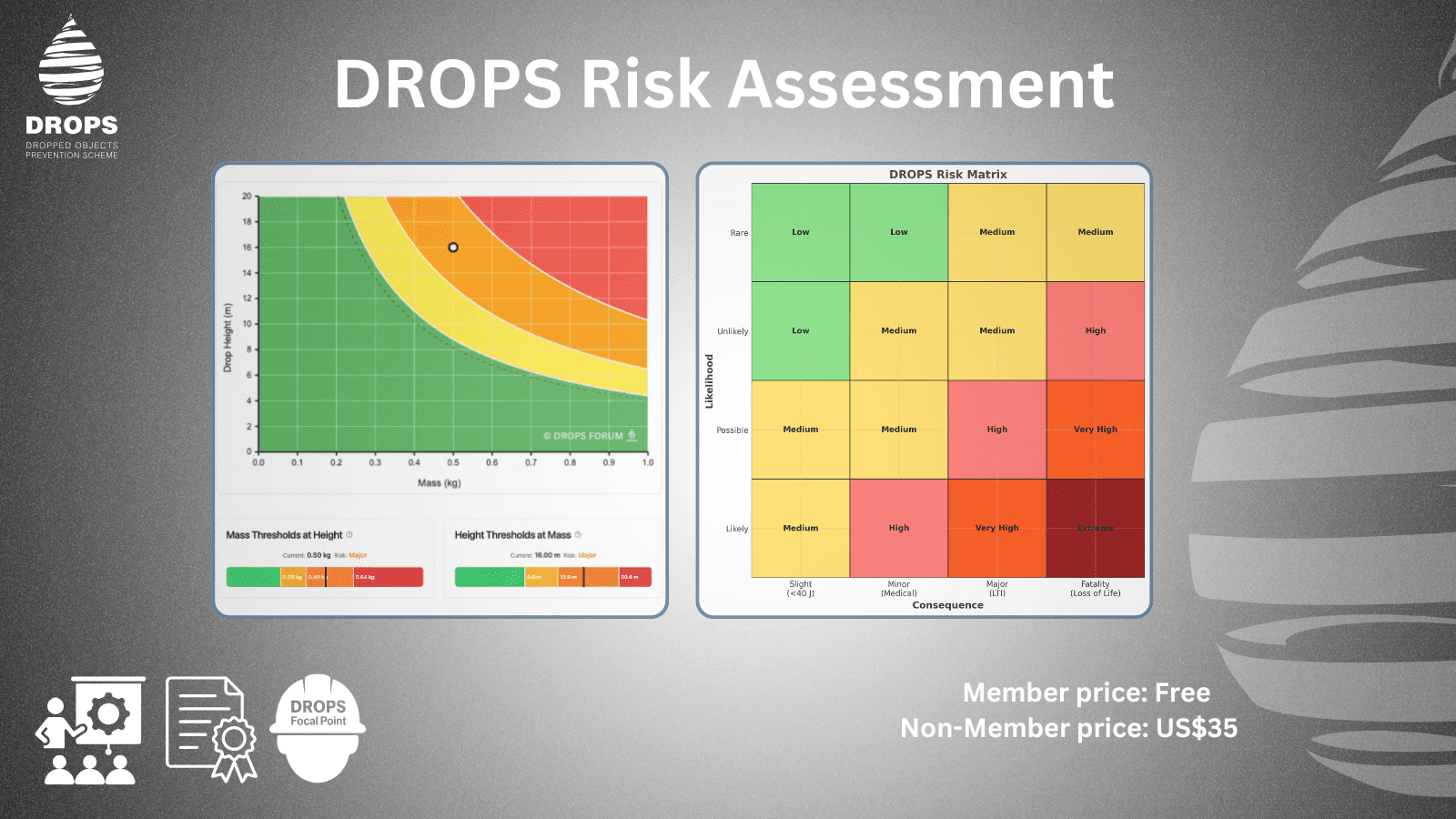
Dropped-object risk is often discussed in terms of severity alone, but potential consequence without likelihood is not risk. Many organizations rely on the DROPS Calculator to estimate potential harm, then struggle to translate that insight into day-to-day decisions, prioritization, and verifiable controls.
This workshop provides a clear pathway: from accurate consequence modeling to practical likelihood assessment, and finally to confident, defensible decisions that reduce exposure on the rig floor, in yards, and across logistics.
The workshop opens with a structured foundation in consequence modeling. Participants learn what the DROPS Calculator does—and does not—tell you. We cover required inputs (mass, height, impact surface), interpretation of severity bands, and common misuses such as over-precision, ignoring surface effects, or skipping evidence capture.
From this base, we move to likelihood—the usual weak spot in DROPS assessments. We base it on evidence from past incidents and near‑misses inside your organization and from comparable operations outside. We also make a clear distinction: (1) the chance a drop will occur, and (2) the chance that a drop will harm someone. The second depends on whether people are present and in the line of fire, how long they are exposed, and what shielding or deflection exists.
To estimate likelihood of harm, we use three inputs: internal data (incident and near‑miss counts, defect discovery, zone‑breach and proximity alerts) normalized by exposure hours or inspection points; external benchmarks (industry alerts, DROPS forums, IADC, IMCA, peer operators/vendors) filtered for similar tasks, environments, equipment and controls; and signals of control effectiveness from audits and re‑inspections. We show how to weight recent and severe events more heavily and how to translate the evidence into simple likelihood bands. We also call out common pitfalls—under‑reporting, stale registers, survivor bias, or using data from dissimilar work—and how to note assumptions and uncertainty without slowing decisions.
The session then integrates consequence and likelihood into a single, actionable risk picture. Instead of using a pre-set grid, participants build a risk matrix suited to their organization: define axes and scale (e.g., 5×5 or 6×6), set plain‑language likelihood bands anchored in internal/external evidence, and translate consequence bands from the DROPS Calculator. We establish color thresholds and escalation rules aligned to company tolerability criteria and client requirements, then calibrate the draft matrix against recent incidents and near‑misses, check for unintended incentives, and document assumptions. Finally, the workshop links an objective risk rating to proportionate controls. We map each matrix band to a defined control set using the hierarchy of controls: elimination/redesign, engineered barriers (secondary retention, guards, nets), administrative measures (exclusion zones, checklists), and PPE.
Low ratings translate into baseline actions (routine checks, standard tethering, periodic verification).
Medium ratings add barriers and verification (secondary retention, sized exclusion zones, torque/inspection evidence, supervisor sign‑off).
High ratings trigger elimination or redesign where practicable; if not, engineered containment, hard barricades, access restrictions, increased inspection frequency, and leadership authorization before work proceeds. Participants leave with a control‑mapping template tied to their matrix for immediate use.
Target Audience
DROPS focal points, HSE professionals, supervisors, DROPS Inspectors, and operations leaders responsible for assessing and controlling objects-at-height risk. Attending a basic DROPS awareness course prior to this workshop is recommended but not required.
Certification
Participants may complete a brief knowledge check at the end of the workshop. Those who attend the full session and pass will receive a Certificate of Attendance recognizing competency in consequence–likelihood risk assessment for DROPS.
Pricing
Free for DROPS Asia Chapter members. Non-members: USD 35 course fee. This workshop is part of the foundational track for the upcoming DROPS Focal Point Program, scheduled for rollout in 2026.
Workshop Duration
~60 minutes.